- Debrief - The undercover dispatch
- Posts
- A Spy on Board: How Israel Infiltrated the Gaza Flotilla
A Spy on Board: How Israel Infiltrated the Gaza Flotilla
The Swedish agent who infiltrated the Freedom Flotilla on behalf of an organization tied to the Mossad and the Israeli government.

Sacha Biazzo
24 ottobre 2025
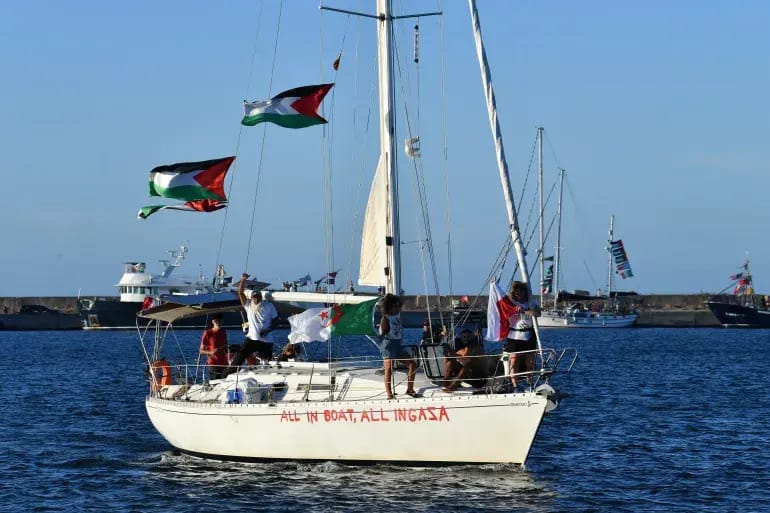
The scene could have come straight out of a thriller: summer 2018, the Mediterranean Sea. A ship from the Freedom Flotilla had set sail from Sicily, bound for Gaza with an international crew of activists determined to challenge Israel’s naval blockade. But something wasn’t right on board. The engine began to suffer mysterious breakdowns, the toilet kept clogging despite repeated instructions, and one night the steel cable running along the deck — the last barrier preventing anyone from falling overboard — was found cleanly severed, for no apparent reason.
The crew grew tense. Someone, they feared, was trying to sabotage the mission. All eyes soon turned to a young Swedish woman with polite manners and a disarming smile. She laughed easily, spoke little, and avoided political conversations. Yet something about her — too curious, too elusive — set off alarm bells. No one suspected that the woman calling herself “Alice” was in fact an undercover agent sent by Israel.
Behind the cover identity of “Alice” was an apparently unremarkable Swedish citizen working for an Israeli organization that for years has sought to delegitimize international solidarity with Palestine, portraying it as a front for Hamas terrorism.
This edition of Debrief reconstructs how the Israeli group Ad Kan spent years infiltrating, sabotaging, and discrediting solidarity movements around the world — and how its operation was revived as propaganda against the Global Sumud Flotilla 2025.
It’s the story of an undercover operation in service of power — the very opposite of the undercover reporting we defend here at Debrief: the kind that exposes abuses instead of inventing alibis.
This issue is written by Sacha and edited by Luigi.
In This Issue of Debrief:
Who Is “Alice”: A Swedish Spy
Subsequent journalistic investigations revealed the portrait of a double life worthy of a spy film. The woman, whose internal codename was “R”, is in her early thirties and comes from a small town in provincial Sweden. In her youth she had been active in the Moderata ungdomsförbundet (MUF), the youth wing of Sweden’s center-right Moderate Party — hardly the background of a radical left-wing activist. In the early 2010s she moved abroad, living in Norway and Denmark; according to tax records reviewed by the independent Swedish newspaper Dagens ETC, she had no declared income in Sweden since 2013.
By her own later account, Alice/R arrived in Israel around 2017 through an internship she obtained while studying landscape architecture. There she reportedly met and began a relationship with a young Israeli soldier, who allegedly introduced her to Ad Kan, an ultra-nationalist organization specializing in undercover operations. From that point on, her life took a decisive turn: R was recruited, trained, and deployed as a covert asset to infiltrate pro-Palestinian solidarity networks across Europe and the Middle East.
Between 2017 and 2019, the young woman—operating under various aliases, of which “Alice” was only the most well-known—managed to gain access to highly sensitive environments. She joined, for instance, the International Solidarity Movement (ISM), a well-known network of international activists supporting the Palestinian cause. She appeared both in Denmark and in the occupied Palestinian territories, posing as an idealistic volunteer while secretly recording conversations and collecting contacts for her handlers. Those field credentials would later earn her enough trust and references to open the door to her next major assignment: the Freedom Flotilla 2018.
In hindsight, Alice’s behavior in the weeks leading up to the voyage revealed a meticulous plan. Jeannette Escanilla, chair of Ship to Gaza Sweden, recalls that the woman had insistently volunteered months in advance, presenting herself as eager to “help” with logistics. Yet her questions were oddly specific: she wanted to know the exact route of the ship and even see the full list of passengers.
After an initial refusal to include her, Alice did not give up. She traveled across Europe to meet various coordinators of the Freedom Flotilla—from London to Copenhagen to Uppsala, where she visited Escanilla herself—weaving a network of contacts and collecting endorsements until the international coalition finally accepted her on board. At the last minute, aided by the absence of a few crew members, Alice secured a place on the final leg from Palermo to Gaza, where she would carry out her most significant role.
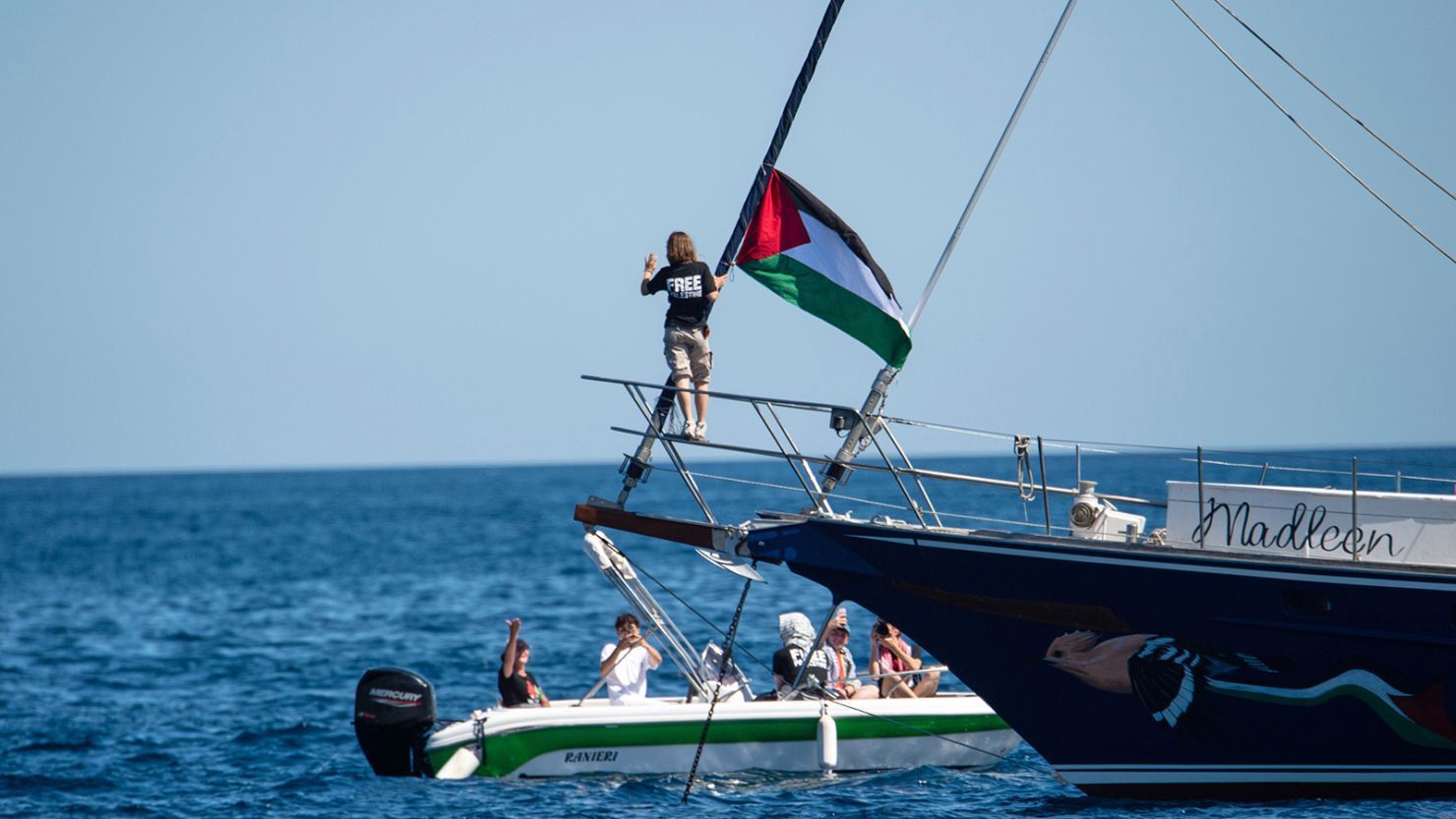
Alice in a Sea of Lies
In the middle of the Mediterranean in 2018, when the crew noticed the broken cable, they realized that someone was trying to tamper with the ship. “It was the most frightening thing — a direct threat to life. If anyone had fallen into the water, they wouldn’t have made it,” recalled Collan Staiger, the ship’s cook, speaking to the Swedish press.
As the boat sailed from Palermo toward Gaza, suspicion turned into alarm. Collan caught Alice trying to force open a locked cabinet — inside were electronic devices, including a transmitter that the flotilla planned to use to livestream the moment (inevitably) when the Israeli navy would intercept them. Another time, she was seen rummaging near a storage locker that contained an important communications device. Was she sabotaging the mission? The atmosphere on board grew tense, almost like a detective novel. “It was like a damn Agatha Christie story,” Collan Staiger joked bitterly.
Eventually, the truth surfaced in the middle of the Mediterranean: Alice was hiding a laptop and a satellite phone in her bag, both explicitly banned on board for security reasons, as they could easily be traced. “That was the last straw,” recalled Ellen Hansson, another Swedish activist on deck. Ellen confronted her: “Do you have any electronic devices with you? Are you absolutely sure you don’t have anything?” The young woman denied it firmly. Cornered, she improvised a sentimental excuse — claiming the satellite phone was to stay in touch with her gravely ill father — but no one believed her. Furious yet unwilling to abandon her at sea, the activists made a drastic decision: they gathered all of Alice’s electronics and threw them overboard.
A few hours later came the epilogue. The flotilla was intercepted by the Israeli navy about 50 miles from Gaza, still in international waters. An armed commando in masks boarded the vessel, taking control without resistance. All passengers, including Alice, were arrested. Yet even amid the chaos, the Swedish woman’s behavior stood out. Once transferred to the port of Ashdod and placed in separate holding cells, Alice disappeared for several hours. When she reappeared, witnesses saw her chatting amiably in Hebrew with Israeli police officers, sipping coffee and eating a sandwich they had given her. “Everyone else was devastated; she was perfectly calm, as if nothing had happened,” recalled Jeannette Escanilla, president of Ship to Gaza Sweden. At that point, suspicion turned into certainty: the spy had been unmasked.
After 2018, the Swedish agent vanished from activist circles — at least under the name Alice. But her mission on behalf of Israel was far from over. There are indications that in 2020 she infiltrated a third Palestinian organization in the West Bank. Then, abruptly, in 2023, R resurfaced in Sweden. Returning from a stay in Tel Aviv that April, she applied a month later to the Swedish Police Academy. Her results in the physical and psychological tests were excellent — top scores — and she was admitted as a reserve officer at one of the country’s most prestigious police schools.
Ad Kan: Israel’s Undercover Network
Who pulls the strings behind “Alice” and other moles infiltrating pro-Palestinian solidarity networks? All signs point to Ad Kan, an organization founded in Israel in 2015 with the stated goal of exposing supposed “subversive” activities within Palestinian rights movements. The name Ad Kan in Hebrew means “Up to here”—as in, “Beyond this point, we won’t let you go.” Founded by far-right activists, including Gilad Ach, a former army officer, the NGO operates effectively as an ultranationalist private intelligence agency. Its members recruit and train young operatives—like R—to go undercover inside NGOs, peace groups, and pro-Palestinian initiatives, gathering inside information to discredit their leaders.
Though it presents itself as a private entity, Ad Kan maintains deep connections with Israel’s state apparatus. Its staff includes former agents of the Shin Bet (Israel’s internal security service) and the Mossad. Some active intelligence officials even appear—albeit anonymously—in documentaries produced by the organization, underscoring its close ties to Israel’s security establishment.
When Alice was embedded in the 2018 Freedom Flotilla, Ad Kan was in constant contact with government authorities. According to one investigation, the NGO’s leadership alerted Israel’s Foreign Ministry as soon as the ship carrying Alice entered the eastern Mediterranean, informing officials that one of their agents was on board. This would explain why, after the Israeli navy’s raid, the names of all detained passengers appeared in official reports—except hers. Moreover, while every other activist was banned from Israel for ten years (the standard measure for “undesirables”), R/Alice was able to return to Israel just three months later to continue her work—an impossible privilege without government backing.
Ad Kan has built its reputation—or infamy—through a series of high-profile media operations. In 2022, together with Israeli journalist Zvi Yehezkeli, the group produced a television docuseries titled Shtula (“The Plant,” Hebrew slang for an undercover operative) broadcast on Channel 13. Its protagonist: the very same R, portrayed as a courageous Western activist who infiltrated “Israel’s enemies.” Across five episodes, the series chronicled her “mission” between 2017 and 2019.
The program shows Alice/R using a hidden camera while mingling with Palestinian volunteers and NGOs across Europe—including moments on board the 2018 flotilla—painting the movement as a nest of anti-Israel extremists. Over the years, Ad Kan has staged multiple undercover “investigations” that made headlines in Israel. They infiltrated groups such as Breaking the Silence—which collects testimonies from Israeli soldiers critical of the occupation—and several human-rights organizations, seeking to undermine them from within. In some cases, the materials gathered by Ad Kan were passed on to security agencies or police, leading to arrests and investigations that later collapsed in court.
Despite its loud rhetoric, Ad Kan has never produced decisive evidence to support its claims. The “proof” it showcases tends to crumble under scrutiny. In fact, even Israeli courts have criticized the organization for its deceptive tactics, data manipulation, and the reputational harm caused to individuals falsely labeled as terrorists or antisemites. Within Israel, Ad Kan is increasingly seen as the covert arm of the country’s most hardline political factions.
From 2018 to 2025: Infiltration as Political Strategy
The “Alice” operation did not end with the Freedom Flotilla of 2018. During the Global Sumud Flotilla of 2025, Ad Kan released on social media new footage filmed by agent R—now nicknamed “the Swedish undercover”—purporting to document that very flotilla. It remains unclear how directly R was involved in the 2025 campaign; after her exposure in 2018, it would have been risky to deploy her again among European activists, many of whom now knew her face and story.

When Alice’s real identity was exposed, the story caused an uproar in Sweden. In January 2024, the independent daily Dagens ETC published a detailed investigation titled “Svenska tjejen blev spion – för Israels räkning” (“The Swedish girl who became a spy—for Israel”). Reporters Joakim Medin and Sofie Axelsson managed to locate the woman on a university campus, where she was studying to become a police officer, and confronted her in the hallway outside her dorm room. The exchange was surreal. Alice/R denied everything, calling the allegations “lies” and claiming she felt “very exposed.” She refused to answer questions about her years-long mission for Israel—questions that touched on possible personal or ideological motives, including speculation about family or religious ties, none of which have been confirmed. Instead of offering an explanation, the agent set strict preconditions for an interview—conditions that would have allowed her to control the content—and, when the journalists refused, she immediately retained a high-profile lawyer to pressure them legally.
Meanwhile, the political scandal was growing. On Swedish social media, left-wing circles and pro-Palestinian activists expressed outrage: a Swedish citizen had acted as an agent in the pay of a foreign power, infiltrating lawful, peaceful associations on Swedish soil. Dagens ETC also revealed that Alice/R had met with activists and collected information inside Sweden itself—for instance, during a visit to Jeannette Escanilla in Uppsala—raising the possibility that she had committed the crime of illegal intelligence activity on behalf of a foreign state, which under Swedish law can carry up to one year in prison (or four in aggravated cases).
Today, the figure of the Swedish spy has become emblematic in international debates on the ethics of undercover journalism. For Ad Kan and pro-government media, Alice/R is portrayed as a kind of “investigative journalist” who uncovered inconvenient truths. In reality, her role was the opposite of journalism: she did not expose the powerful or document hidden abuses—she worked for the powerful, targeting those who sought to reveal them.
The story of Alice and Ad Kan stands as a reminder of why ethics in investigative reporting matter more than ever—because there will always be governments and interests eager to dress falsehood as truth, to call “investigation” what is, in fact, pure propaganda. It is up to us to uncover the difference.
Until the next Debrief,
Sacha & Luigi
If you've come across an undercover investigation you think we should feature, share it with us here:
👉 https://forms.gle/1JbqMBJUfoRU9MBp7
If you have suggestions, questions, tips (or insults), drop us a line at:
👉 [email protected]
If you enjoyed this newsletter, pass it along to your friends using this link:
👉 https://debrief-newsletter.beehiiv.com/
Follow us on Instagram, occasionally we'll upload content different from the newsletter:
👉 https://www.instagram.com/debrief_undercover/
We've also launched a podcast featuring interviews with the authors of memorable undercover investigations:
👉 https://open.spotify.com/show
And if that's still not enough, join our Telegram channel, where we can keep the conversation going:
👉 https://t.me/debrief_undercover
Reply