- Debrief - The undercover dispatch
- Posts
- All of Jeffrey Epstein’s Hidden Cameras
All of Jeffrey Epstein’s Hidden Cameras
Why was every Epstein residence wired with cameras (often hidden) in every room, including bedrooms and bathrooms? And why was a foreign government running the surveillance system in a building where Epstein’s victims lived?

Sacha Biazzo
27 febbraio 2026
On February 5, 2014, Jeffrey Epstein sent his personal pilot, Larry Visoski, a brief email: "Lets get three motion detected hidden cameras, that record, thanks." Five hours later, Visoski replied: "Jeffrey, I already two purchased the Motion sensor camera from the Spy Store in fort Lauderdale yesterday… Its amazing how small they are, the size of Thumb nail drive, 64 hour recording, Motion sensor. I'm installing them into Kleenex boxes now."
This email exchange is quite explicit. It confirms something that Epstein’s victims had been reporting for nearly thirty years and that institutions pretended not to see. Jeffrey Epstein operated a hidden surveillance system across his properties, specifically designed to film guests in their most intimate moments, without their knowledge.
What the documents released in 2026 are allowing us to reconstruct is something broader and more organized than anyone had officially admitted. A surveillance infrastructure spread across multiple properties, with miniaturized cameras disguised as household objects, a monitoring room with secret access, a physical archive of CDs and hard drives organized like an evidence warehouse. And through all of this, at least one foreign government was simultaneously running its own security system in the very building where Epstein housed his victims.
This issue is written by Sacha and edited by Luigi.
In This Issue of Debrief:
The Kleenex Boxes and the Fort Lauderdale Spy Store
The store is called RNMC, located on West Oakland Park Boulevard in Fort Lauderdale, Florida, and the sign outside the door reads "SpyShops Security Superstore." Epstein’s American Express statements, obtained by the Telegraph, confirm two purchases at RNMC on February 4, 2014, totaling over a thousand dollars (professional-grade equipment, in other words), the day before Visoski reported having already bought them.
The cameras Visoski described — the size of a USB drive, with up to 64 hours of recording and motion detection — were intended, based on the email context, for the estate at 358 El Brillo Way, Palm Beach, Florida, where Epstein had his primary residence. Visoski, who lived in Fort Lauderdale, offered to bring them personally "later that day."
That same morning, a sender whose identity was redacted by DOJ censors had written to Epstein: "Remember what we spoke about if you want to put cameras in the house. It will have to be very discreetly done. The Russians may come in handy." There are no further references to "the Russians" in the correspondence about the cameras. But the context of that sentence has never been clarified.
A frame taken from a surveillance video inside his home in Florida.
Another email, this one from 2012 (document EFTA01840141), shows Epstein asking a collaborator named Scott Denett "for Wednesday please suggest some web enabled security surveillance cameras?".
What makes this story particularly significant is that no one ever deemed it necessary to ask what those hidden cameras were for, despite the victims knew and had been reporting it for decades, but no one had ever truly listened to them.
The Secret Room on the Ground Floor in Manhattan
The townhouse at 9 East 71st Street, on Manhattan’s Upper East Side, is a seven-story, forty-room building of approximately 18,800 square feet. Les Wexner, the billionaire founder of L Brands, had purchased it in 1989 for $13.2 million, at the time the highest price ever recorded for a private sale in Manhattan. Epstein took possession around 1995 and used it as his primary residence and operational hub until his arrest.
On the ground floor, on the right side of the facade, there was a small room that did not appear on any floor plan: a surveillance room bearing a sign: "24 Hour Video Surveillance."
Maria Farmer, who in 1996 worked as a "doorwoman" at the residence and was one of Epstein’s earliest accusers, reported him to the New York police and the FBI in August of that year, when she was 26, and described the room in a CBS News interview in November 2019. She recalled that Epstein, as soon as she entered the building, personally showed her the room: "There was a door that looked like an invisible door with all this limestone and everything. And you push it, and you go in." Inside, old monitors stacked in a cabinet, with men actively watching them. Farmer recounted approaching the screens and seeing: "toilet, toilet, bed, bed, toilet, bed. I'm like, 'I am never gonna use the restroom here and I'm never gonna sleep here.'" Those were the live feeds from the building's bathrooms and bedrooms.
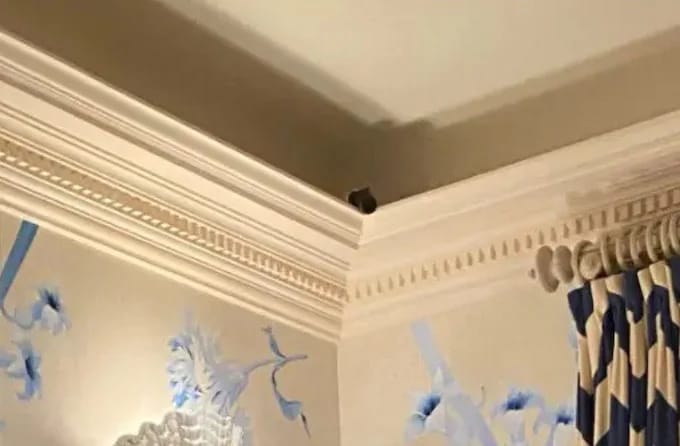
One of the surveillance cameras inside his New York residence.
DOJ photographs taken during the 2019 raid, examined by the New York Times in August 2025, showed at least one camera mounted in a corner above Epstein’s bed, a second hidden in the moldings of an adjacent room, and a third near a row of bathrooms on the same floor. The contradiction with the FBI’s official account is radical: an internal email from the federal agency (document EFTA00164742) states that "there were no cameras found inside any bedrooms or living areas of either residence", which is either a lie or would actually be proof that someone removed the cameras before the agents arrived.
Inside the Safe: Labeled CDs and Diamonds
The raid on the Manhattan residence was conducted on July 6 and 7, 2019, by Special Agent Kelly Maguire of the Child Exploitation and Human Trafficking Task Force. It lasted approximately twelve hours.
On the fifth floor, in a dressing room closet, agents found a locked safe. They did not have the tools to open it. Maguire would testify at the Maxwell trial, on December 6, 2021: "We brought a saw." Inside the safe were hard drives, CDs, CD binders, 48 loose diamonds (one of 2.38 carats), a diamond ring, approximately $70,000 in cash, and multiple passports, including one with Epstein’s photo but a different name, issued by a foreign country.
On a shelf in the same closet, black binders with white labels, transparent sleeves with thumbnail photos and attached CDs, bore handwritten labels such as "Young [Name] + [Name]," "Misc nudes 1," "Girl pics nude." In a ground-floor office, inside a plastic container hidden under a bookshelf, more hard drives. In another closet, boxes of CDs with yellow forensic evidence tape, as if some of those materials had already been handled as evidence in a previous case.
The total seized amounted to over 40 computers, 26 hard drives, 70 CDs, 6 recording devices, totaling approximately 300 gigabytes of data, among which were thousands of photographs of young women, partially or fully nude, at least one of whom was a confirmed minor.
The safe, however, had already been visited once by agents, who had been unable to open it: they had photographed it and left it there. When they returned with a broader warrant, the items were gone. Epstein’s attorney, Richard Kahn, showed up at Maguire’s office shortly after "with two suitcases" containing the same materials, which he claimed to have legally retrieved. Agents confirmed they matched the original photographs, but in the meantime, the items had ended up in the hands of someone with every incentive to cherry-pick what to hand over.
Virginia Giuffre, Epstein’s primary accuser, who died on April 25, 2025, was convinced that Epstein kept videos involving other men. Her co-author Amy Wallace told CBS News: "She didn't just believe it; she knew it."
The Israeli Surveillance System at 301 East 66th Street
On February 18, 2026, Drop Site News published a story that until then had remained completely buried in the 3.5 million pages released on January 30, titled"The Israeli Government Installed and Maintained Security System at Epstein Apartment."
The building is 301 East 66th Street, a sixteen-story postwar condominium on the Upper East Side, between First and Second Avenue. It is formally owned by a company called Ossa Properties, traceable to Jeffrey’s brother, Mark Epstein, who acquired it in the 1990s from Les Wexner. Over 150 of the approximately 200 apartments were controlled through LLCs traceable to the Epsteins. In Jeffrey Epstein’s personal address book, some units were listed as "Apts. for models."
In this building, the Israeli government installed and maintained a remotely controlled security system for at least two years. Not in just any apartment: in the apartment regularly occupied by former Israeli Prime Minister Ehud Barak, who stayed there rent-free.
The proof is in document EFTA00331291, an email dated January 15, 2016, between Nili Priell, Barak’s wife, and Lesley Groff, Epstein’s assistant, whose name appears over 150,000 times in the DOJ files. Priell writes: "They can neutralize the system from far, before you need somebody to enter the appartment. The only thing to do is call Rafi from the consulate and let him know who and when is entering, and he will neutralize it for the time necessary."
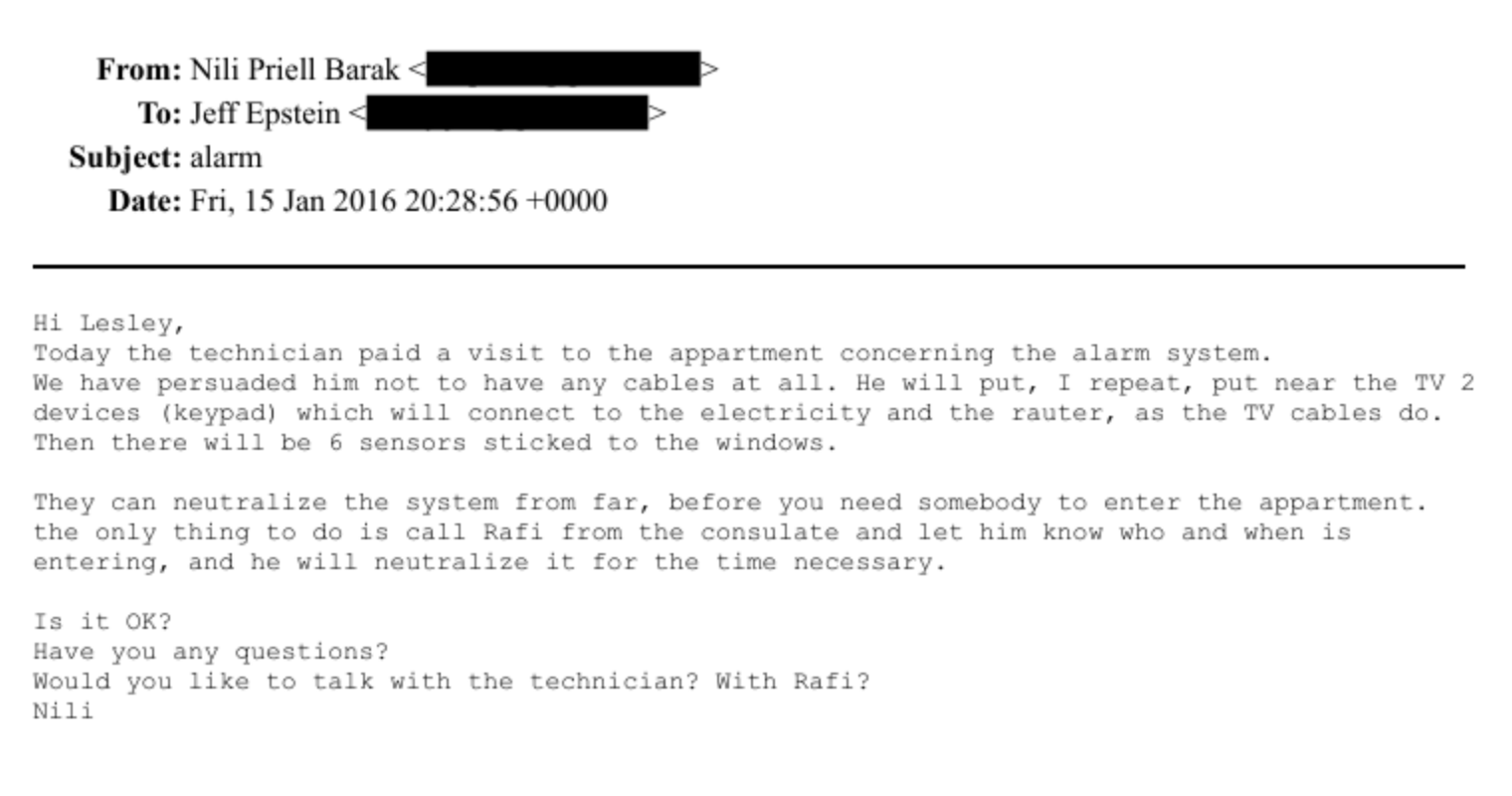
Rafi is Rafi Shlomo, the director of protection services at the Israeli Permanent Mission to the United Nations and responsible for Barak’s personal security detail. He was the system’s operational point of contact. He himself deactivated the alarm remotely before anyone entered. He kept the access lists, vetted the cleaning staff’s credentials, and organized periodic meetings with Epstein’s staff.
Groff replied to Barak and Priell, confirming Epstein’s approval: "Jeffrey says he does not mind holes in the walls and this is all just fine!", because the system required structural modifications: holes in walls, wiring, mounting brackets. The documented components were six sensors applied to windows, an alarm system, and a remote control capability.
DOJ documents show that the operational relationship lasted at least until November 2017, when Shlomo was replaced by another Israeli official who took over security management for Barak. In a February 2017 email, an Epstein assistant writes: "Rafi, the head of Ehud’s security, is asking if I could meet him at 4pm on Tues. 14th at his office (800 2nd Ave and 42nd) re Ehud's apartment... He was not very specific... just said they are doing some reshuffling themselves…". Epstein approved the meeting.
Neither Barak nor the Israeli mission to the UN responded to Drop Site News’s requests for comment. In a December 2018 email found in the DOJ files, Epstein wrote to Barak: "You should make clear that I don't work for Mossad :)" — Barak replied: "You or I?" — Epstein: "That I don't :)" In another email from November 2017, Epstein asked Barak: "Did Boies ask you to help obtain former Mossad agents to do dirty investigations?" e "Boies said he got to the Mossad guys through you?"
In June 2020, a filing by attorney Alan Dershowitz in his defamation lawsuit against Virginia Giuffre cited sealed depositions from the Giuffre v. Maxwell case, in which Giuffre accused Epstein of sexually trafficking her to Barak. In her posthumous memoir "Nobody's Girl" (October 2025), co-written with Amy Wallace, Giuffre recounts being raped by a "well-known prime minister" on Epstein's private island, around 2002, when she was approximately 18 years old. She wrote that the man repeatedly strangled her until she lost consciousness. Giuffre begged Epstein not to send her back to him. Epstein made no promises, saying coldly of the politician's brutality: "You'll get that sometimes." In the memoir, Giuffre does not name the prime minister, stating she feared he would seek to hurt her. Barak, for his part, has always and categorically denied all accusations, calling them "lies without evidence" through his legal team. To date, he does not appear to have taken legal action against Giuffre.
Until the next Debrief,
Sacha and Luigi
If you've come across an undercover investigation you think we should feature, share it with us here:
👉 https://forms.gle/1JbqMBJUfoRU9MBp7
If you have suggestions, questions, tips (or insults), drop us a line at:
👉 [email protected]
If you enjoyed this newsletter, pass it along to your friends using this link:
👉 https://debrief-newsletter.beehiiv.com/
Follow us on Instagram, occasionally we'll upload content different from the newsletter:
👉 https://www.instagram.com/debrief_undercover/
We've also launched a podcast featuring interviews with the authors of memorable undercover investigations:
👉 https://open.spotify.com/show
And if that's still not enough, join our Telegram channel, where we can keep the conversation going:
👉 https://t.me/debrief_undercover
Reply