- Debrief - The undercover dispatch
- Posts
- Epstein increasingly appears to have operated for multiple intelligence services
Epstein increasingly appears to have operated for multiple intelligence services
The newly released Epstein Files are throwing an ever harsher light on an international espionage dimension.

Luigi Scarano
6 febbraio 2026

Only a few days ago, on January 30, 2026, a massive trove of documents (more than 3 million pages, 2,000 videos, and 180,000 images) was made public by the U.S. Department of Justice, shedding new light on Jeffrey Epstein’s covert activities. It will probably take weeks or months to analyze these documents in depth. We already wrote about the pedophile financier’s intelligence ties in an issue a few weeks ago. But for now we can already add at least three shocking new discoveries about Epstein: in 2011 he planned to raid Libyan funds, relying on the availability of former British and Israeli intelligence operatives; he worked behind the scenes to cement the strategic alliance between Israel and the United Arab Emirates; and finally, he even attempted to embed himself within Vladimir Putin’s inner circle, offering himself as an intelligence asset or as a shadow adviser.
These facts alone are enough to suggest an international espionage scenario, in which Jeffrey Epstein played, on his own and/or on behalf of higher powers, the role of an occult broker, a global fixer, embedded in foreign business intrigues and clandestine finance.
This issue is written by Luigi and edited by Sacha.
In This Issue of Debrief:
Among former MI6 and Mossad officers
In the summer of 2011, Libya was in chaos: the uprising against Muammar Gaddafi was raging and the regime was wobbling. In that power vacuum, Jeffrey Epstein saw a billion-dollar opportunity. An email sent to Epstein in July 2011, now surfaced in the Epstein Files, laid out a plan to recover the vast Libyan state funds frozen abroad. At the time, it was estimated that around $80 billion in Libyan money was blocked internationally (including $32.4 billion in the U.S. alone), and that the real figure could be three or four times higher. Epstein and a mysterious associate planned to identify and recover 5–10% of those assets, taking a 10–25% commission: in practice, they aimed to pocket potentially “billions of dollars” from the operation.

From EFTA02032723.pdf
To get their hands on that “frozen” money, Epstein intended to activate a network of extremely high-level people. Former agents of Britain’s MI6 and Israel’s Mossad would provide their support in tracing and recovering the “stolen assets.” Post-Gaddafi Libya, the author of the email argued, would need to spend enormous sums on reconstruction and economic recovery once the civil war ended. “But the real carrot is if we can become their go-to guys because they plan to spend at least $100 billion next year to rebuild their country and jump start the economy,” the email said. In other words, beyond the immediate payoff from unfrozen funds, Epstein wanted to position himself as a fixer for the major contracts of postwar Libya.
This financial scheme reveals the influence dynamics and opaque finance typical of Epstein’s entourage: exploiting a power vacuum in a resource-rich country under UN sanctions, mobilizing former Western and Middle Eastern intelligence figures, to extract enormous economic and political advantages for himself and his network.
A shadow facilitator between Israel and the Emirates
Another unexpected revelation concerns Epstein’s role as a secret bridge between Israel and the United Arab Emirates, long before the Abraham Accords made this alliance public in 2020. From private correspondence brought to light by Drop Site, it has emerged that Epstein, over the last two decades of his life, acted as an informal intermediary between Tel Aviv and Abu Dhabi thanks to his close friendship with Sultan Ahmed bin Sulayem, the influential chairman of port giant DP World and a figure close to the UAE’s political leadership.

Jeffrey Epstein and Sultan bin Sulayem
Epstein had ingratiated himself with Dubai’s elite even before his first 2008 conviction for sexual crimes. In 2009, fresh out of prison, the financier went back to weaving global schemes, boasting of his connections. He claimed to know “the owner of the deep-water port of Djibouti on the horn of Africa, a smuggler’s paradise,” bragging that the friendship was such that “he was basically in charge.” Behind those boasts stood none other than Sultan bin Sulayem himself, the strongman of Dubai’s ports, and today we know that Epstein was not exaggerating at all: the two often appear together in photos released in the files, and in one in particular, shot at Epstein’s residence, they are side by side preparing a dish in the kitchen, clear evidence of a direct personal bond.
Epstein orchestrated meetings and relationships at the very top. In June 2015 he organized a meeting in St. Petersburg between Ehud Barak and Sultan bin Sulayem, joking by email that Barak owed Sulayem a favor for paying the bill at their last meeting. Under his direction, the Tel Aviv–Dubai axis grew stronger: Israel gained openings toward the Gulf in strategic areas, while the Emirates gained access to top-tier Israeli technology and partners. That special relationship helps explain why, as soon as the Abraham Accords were signed, Gulf capital moved with remarkable speed.
The crazy urge to become one of Putin’s “assets”?
The third story emerging from the Epstein Files takes us to Moscow. Jeffrey Epstein, already surrounded by Western billionaires and power brokers, was eager to get into Vladimir Putin’s good graces, and he didn’t give up after repeated refusals. In the newly disclosed documents, Putin’s name appears 1,005 times, sign of an almost obsessive interest on the financier’s part. As early as 2010, just a few years after his first conviction, Epstein was looking for channels to establish direct contact with the Kremlin leader.
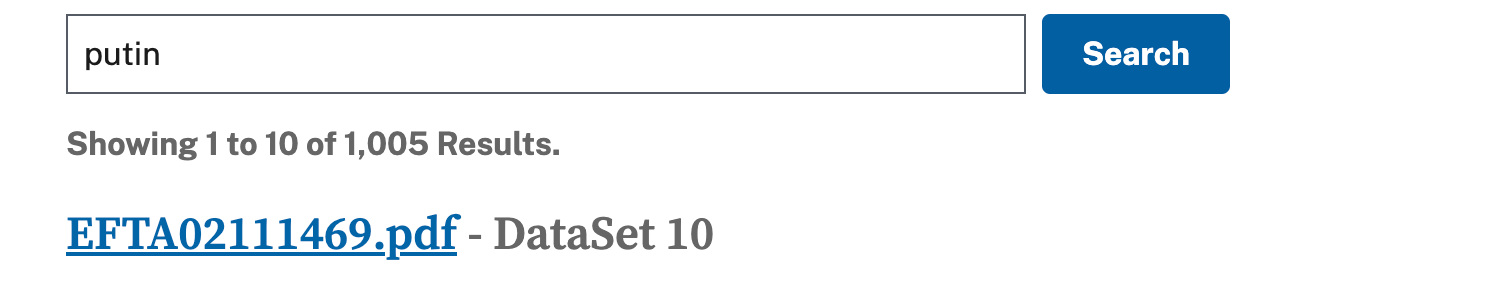
In October 2010 he wrote to an acquaintance asking whether he had ever had Putin as a guest on his yacht. Soon after, he began probing the practicalities of a trip to Russia: “Do i need to get visa,? I have a friend of putin,s, should i ask him?”, he asked in an email as he prepared a Russian visa application. Over the following decade, Epstein tried everything. He even turned to internationally prominent political figures to obtain an invitation to the Kremlin. Among his contacts, one stands out: Thorbjørn Jagland, former Norwegian prime minister and, at the time, secretary general of the Council of Europe. Jagland received several insistent emails from Epstein. In one from May 2013, faced with yet another Epstein proposal to discuss investment plans in Russia, Jagland replied pragmatically: “You have to do it. My job is to get a meeting with him,”. And he added: “Can I say this [to Putin]: I know that you want to attract foreign investment to diversify russian economy [...] I have a friend that can help you to take the necessary measures (and then present you) and ask wether it is interesting for him to meet with you.” In short, the former prime minister seemed willing to pass the message along, but made clear that the ball would remain in Putin’s court.
As the years went by, the ex-financier also played the card of privileged information, a valuable currency in power circles. In June 2018 Epstein wrote to Jagland: “Would love to meet Putin”. Not getting a reply, four days later he ventured a more intriguing offer: he asked Jagland to let Putin know that his foreign minister, Sergei Lavrov, could “can get insight on talking to me”. A cryptic but suggestive proposal: Epstein hinted that he had “insight” to offer, intelligence information, in other words. Perhaps about Donald Trump, whom he had been friends with and who at the time was U.S. President? Or perhaps about some other powerful figure he had cultivated and hosted in his villas? The documents released so far do not confirm, however, whether Epstein ever truly became an asset of the Russian intelligence services. Polish Prime Minister Donald Tusk has announced that he would launch an investigation to seek confirmation of this possibility, while the Kremlin has already replied that the whole affair is a waste of time.
Beyond the hypotheses, these and many other stories once again underscore Epstein’s profile as an influence operator, likely relying on a long list of people he could blackmail and leverage.
Until the next Debrief,
Luigi and Sacha
If you've come across an undercover investigation you think we should feature, share it with us here:
👉 https://forms.gle/1JbqMBJUfoRU9MBp7
If you have suggestions, questions, tips (or insults), drop us a line at:
👉 [email protected]
If you enjoyed this newsletter, pass it along to your friends using this link:
👉 https://debrief-newsletter.beehiiv.com/
Follow us on Instagram, occasionally we'll upload content different from the newsletter:
👉 https://www.instagram.com/debrief_undercover/
We've also launched a podcast featuring interviews with the authors of memorable undercover investigations:
👉 https://open.spotify.com/show
And if that's still not enough, join our Telegram channel, where we can keep the conversation going:
👉 https://t.me/debrief_undercover
Reply