- Debrief - The undercover dispatch
- Posts
- How Israel turns journalists into “undercover terrorists” to justify their assassination
How Israel turns journalists into “undercover terrorists” to justify their assassination
Inside the “Legitimization Cell,” the secret IDF unit that manufactures evidence to portray Palestinian journalists as Hamas militants

Luigi Scarano
5 settembre 2025
This is the first issue of Debrief after the summer break. We had planned to open the month, as usual, with the best undercover investigations from the past 30 days. There are some remarkable ones, and we will cover them, but not today. Because we need to talk about one of the central issues of recent months: the legitimization of the killing of Palestinian journalists, targeted by the Israeli army after being branded as “terrorists disguised as reporters.”
On August 14, the Israeli magazine +972 revealed the existence of a secret Israeli military intelligence cell with a very specific mission: to gather “evidence” that could be used to brand Palestinian journalists as Hamas operatives. This goes far beyond mere propaganda. Once a reporter is labeled an “undercover terrorist,” they lose both the protection of international law and their public credibility, two conditions that make them a legitimate target in one of the bloodiest conflicts in history for civilians.
In this issue, we step inside that machinery of delegitimization: how it works, the cases it has already produced, and why parts of the Western press continue to amplify it.
This issue is written by Luigi and edited by Sacha.
In This Issue of Debrief:
“Legitimization Cell”: the Israeli unit that turns journalists into targets
On August 14, the independent Israeli outlet +972 Magazine, together with the Hebrew-language publication Local Call, published an investigation revealing the existence of a secret Israeli military intelligence structure known as the “Legitimization Cell.” According to three intelligence officers who spoke anonymously to journalist Yuval Abraham, this unit was created immediately after Hamas’s October 7, 2023 attack, with a specific mission: to collect and “declassify” information from Gaza that could be used to improve Israel’s image abroad.
The unit systematically trawled through intelligence material to fuel the media war (hasbara), releasing “evidence” of Hamas using schools or hospitals for military purposes, or of Palestinian rockets falling on civilians in Gaza. Most importantly, however, the team was tasked with identifying journalists in Gaza to be presented as undercover Hamas members—an effort designed to blunt global outrage over the killing of Palestinian media workers and ease international pressure on the Israeli government.
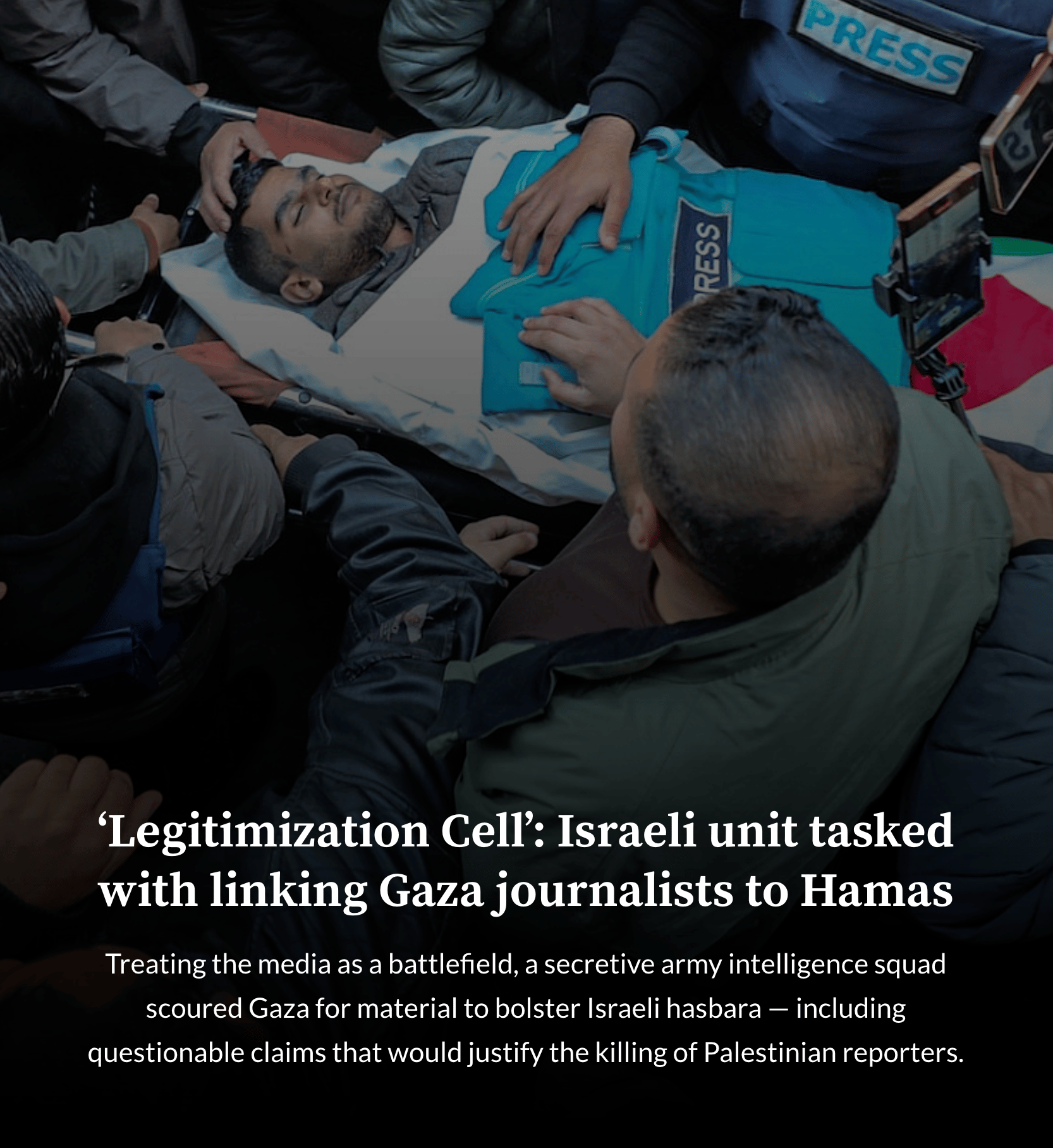
From the +972 Magazine investigation
As the investigation reports, Israel’s political leadership directly influenced the cell’s “priorities,” indicating which themes to focus its hasbara efforts on at any given time. This confirms that the unit’s primary motivation was not operational or military, but political and propagandistic. Whenever international criticism mounted on a specific issue, the team was instructed to quickly dig up publishable material from the database to flip the narrative. One member of the group, quoted in the article, summed up their approach as follows: “If the global media is talking about Israel killing innocent journalists, then immediately there’s a push to find one journalist who might not be so innocent — as if that somehow makes killing the other 20 acceptable.”
In some cases, this even led to stretching or manipulating the information collected, just to present “evidence” supporting the Israeli version. One unit member said that, at least in one instance early in the war, the cell hastily identified a journalist as a supposed Hamas operative and prepared to eliminate him by publicizing his alleged affiliation. In the end, it turned out he was in fact a journalist, and the strike was canceled. But that caution has eroded in recent months.
“Undercover terrorists”: the narrative that kills journalists
One of the most striking cases in which the Legitimization Cell worked to justify the killing of Palestinian journalists is that of Anas al-Sharif, a 28-year-old Al Jazeera reporter who was killed on August 10, 2025, in a targeted bombing along with four colleagues. Immediately after his death, the IDF released documents claiming he had been a Hamas member between 2013 and 2017. Yet those same reports—never independently verified—also indicated that his alleged activity had ended several years before the latest conflict began.
Israel had long had Anas al-Sharif in its sights. As early as October 2024, his name appeared on a “kill list” labeling six Al Jazeera journalists as operatives of Hamas or Islamic Jihad, circulated by the IDF complete with photos. Just days before his killing, the Committee to Protect Journalists issued an urgent appeal for his protection, denouncing the army’s smear campaign portraying him as a “journalist undercover terrorist.”

The kill list released by the IDF
Al-Sharif was known for his frontline reporting during the war and had been part of the Reuters photography team that won the 2024 Pulitzer Prize for Breaking News Photography. As The Guardian also noted, the IDF never explained how al-Sharif could possibly have “balanced” a supposed role as a Hamas commander with his visible daily work as a reporter in one of the most heavily monitored areas in the world.
A similar fate befell his colleague Ismail al-Ghoul, a 27-year-old Al Jazeera correspondent, killed together with cameraman Rami al-Rifi in a raid on the al-Shati refugee camp in July 2024. In this case, the IDF posthumously branded him as a “Nukhba terrorist,” part of Hamas’s special forces, citing a 2021 document that absurdly claimed he had been granted a military rank back in 2007, when he was only ten years old.
Despite mounting global criticism for targeting journalists, Israel has continued its attacks. On August 25, the Israeli air force bombed Nasser Hospital in Khan Younis in a “double tap” strike: a first air raid followed by a second launched after rescuers and reporters had already arrived on the scene. The attack killed at least 20 people, including doctors, patients, and five journalists: Reuters cameraman Hussan al-Masri, Associated Press journalist Mariam Abu Daqqa, Mohammad Salama, who contributed to Al Jazeera and Middle East Eye, Reuters photographer Moaz Abu Taha, and Ahmed Abu Aziz of Quds Network and Middle East Eye.
The IDF confirmed the hospital bombing, stating it “regrets any harm to uninvolved persons” and that it “does not target journalists as such.” Prime Minister Benjamin Netanyahu described the incident as a “tragic accident” for which Israel “deeply regrets.” The army later partially revised its account, claiming the two strikes were actually aimed at a “Hamas surveillance camera.”
When media become weapons: the BibiLeaks scandal
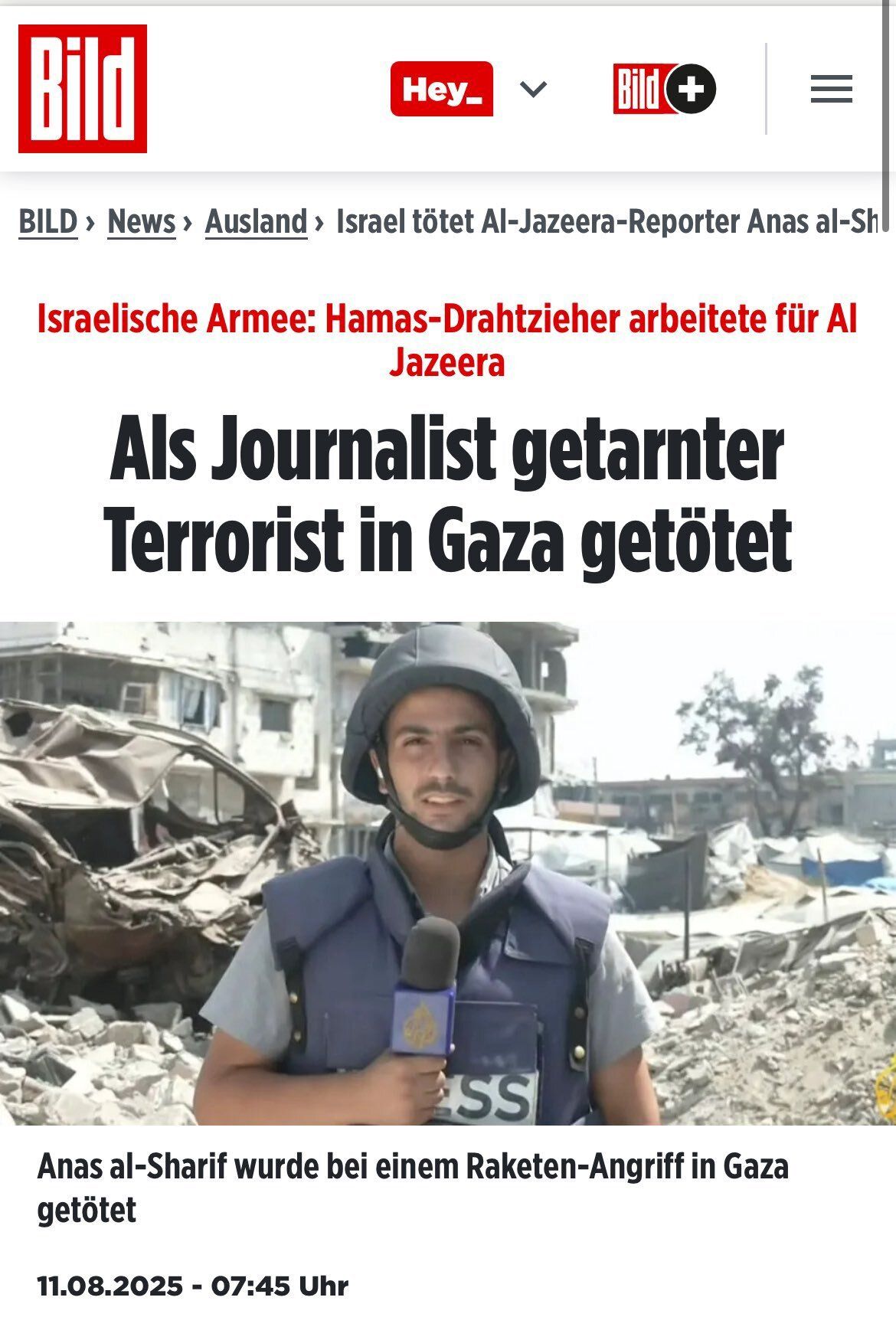
Immediately after the death of Anas al-Sharif, many international outlets uncritically echoed the IDF’s version, headlining that the reporter was in fact an “undercover terrorist.” Among them stood out the German daily Bild, which instantly gave credence to the Israeli military’s dossiers. This came as no surprise: just days earlier, the same paper, Germany’s highest-circulation newspaper, had published a story casting doubt on the work of photojournalists in Gaza, implicitly accusing them of exploiting hunger and devastation to spread “propaganda” against Israel. Such an approach is consistent with the editorial line of Axel Springer—the publishing house that owns Bild, Die Welt, Poland’s Fakt, and the U.S. sites Business Insider and Politico—which enshrines as a founding principle the commitment to support the Jewish people and “the right of the State of Israel to exist.” This unconditional support translates into a heavily skewed editorial stance, with little willingness to question the government’s official narrative.
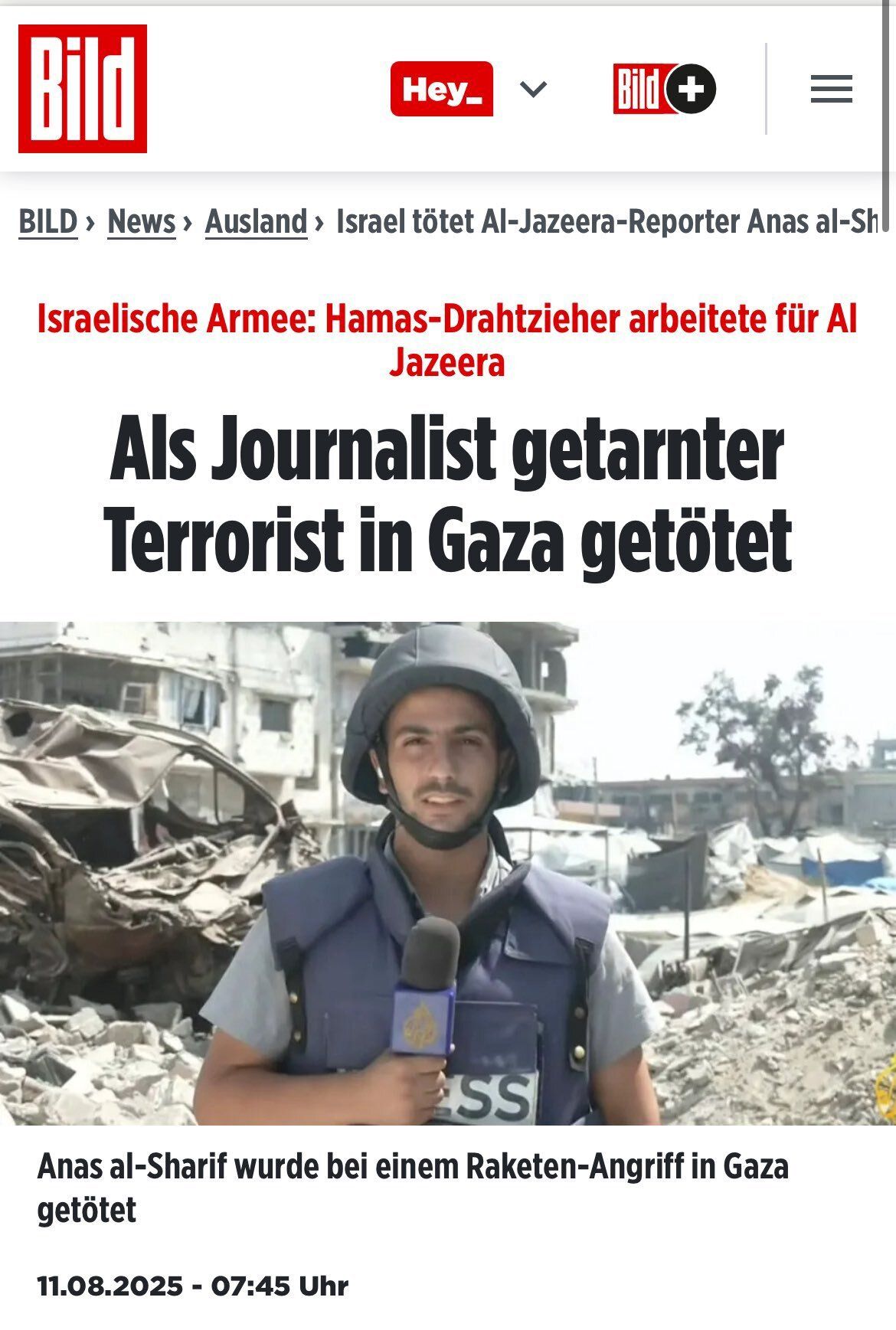
Bild’s article on the death of Anas al-Sharif: “Terrorist disguised as journalist killed in Gaza”
In September 2024, for example, Bild published what it presented as a secret Hamas document—allegedly found on leader Yahya Sinwar’s computer in a tunnel in Gaza—purporting to outline the group’s strategy: dragging out ceasefire negotiations as a form of psychological warfare to weaken Israel. Bild framed the story as based on “classified” leaked documents. In reality, according to the IDF itself, the material was a memo written by a mid-level Hamas member and recovered months earlier. Moreover, the key line cited by Bild—in which Hamas supposedly revealed its intent to sabotage negotiations—was nowhere to be found in the original document. In short, Bild attributed to Hamas a strategic plan that was never documented, adding details that did not exist. According to the German investigative program Panorama, these fabrications directly served the interests of Prime Minister Benjamin Netanyahu. Indeed, Netanyahu immediately exploited Bild’s “revelation,” explicitly citing the article in a cabinet meeting to justify his hardline approach and claiming that pacifist protesters in Israel were falling into Hamas’s trap.
The Bild case is not an isolated one. Starting in autumn 2024, the office of Prime Minister Benjamin Netanyahu became embroiled in a massive media scandal that came to be known as BibiLeaks. In short, members of Netanyahu’s staff are accused of leaking classified documents and manipulated information to selected foreign outlets, with the aim of influencing public opinion and deflecting blame from the Israeli government for the failure of ceasefire negotiations in Gaza.
Israel and the voices of journalists who refuse to stay silent
Despite the climate of war and censorship, Israeli civil society has seen important initiatives of solidarity with journalists under attack. On August 13, 2025—on the eve of the publication of the +972 Magazine investigation and following the death of Anas al-Sharif—dozens of Israeli journalists took to the streets in both Tel Aviv and Nazareth, demanding an end to the bombings in Gaza, a halt to the killing of reporters, and denouncing the “complicity” of national media. During the protest, participants read out a statement: “We express full solidarity with our colleagues in Gaza, we demand that our government immediately stop harming them, and that an independent investigation be opened into the cases of the journalists who have been killed.” The petition was later signed by 131 Israeli journalists and made public on September 1.
“Throughout the war, an absurd situation has been created in which everywhere in the world more is known about our actions in Gaza and the West Bank than we ourselves know,” the Israeli journalists wrote—pointing directly to the internal blackout caused not only by military censorship but, above all, by the self-censorship of a press aligned with the government’s version of events. The text explicitly accused Israeli media of betraying their duty by failing to show the real devastation in Gaza: “The biggest problem for the press in Israel is self-censorship.”
Journalism as a target, memory as the enemy
Gaza is today the most dangerous place in the world for those who report the news: since October 7, Israel has killed more media workers than those who died in both World Wars, the Korean War, Vietnam, Afghanistan, and the Balkan conflicts combined. But the war in Gaza shows that it is not only journalists’ lives that are under attack, but the entire Palestinian cultural ecosystem. To the catalogue of devastation must be added the systematic destruction of schools—nearly 90% have been damaged or leveled—and the elimination of writers and intellectuals, such as poet Refaat Alareer, who was killed in an airstrike alongside his family after weeks of threats. The strategy behind his murder is the same one that led to the killing of Al Jazeera reporter Anas al-Sharif: to eliminate those who tell the story, those who write, those who transmit memory.
Taken together, all this reveals the true nature of the Legitimization Cell: a mechanism designed to manufacture “evidence” to turn journalists into “undercover terrorists,” normalizing their killing and sterilizing international outrage. And that is why the existence of this intelligence unit is not only about Gaza or Israel. If it becomes acceptable to target a journalist simply because they are inconvenient, then no democracy can consider itself safe.
Until the next Debrief,
Sacha and Luigi
If you've come across an undercover investigation you think we should feature, share it with us here:
👉 https://forms.gle/1JbqMBJUfoRU9MBp7
If you have suggestions, questions, tips (or insults), drop us a line at:
👉 [email protected]
If you enjoyed this newsletter, pass it along to your friends using this link:
👉 https://debrief-newsletter.beehiiv.com/
Follow us on Instagram, occasionally we'll upload content different from the newsletter:
👉 https://www.instagram.com/debrief_undercover/
We've also launched a podcast featuring interviews with the authors of memorable undercover investigations:
👉 https://open.spotify.com/show
And if that's still not enough, join our Telegram channel, where we can keep the conversation going:
👉 https://t.me/debrief_undercover
Reply