- Debrief - The undercover dispatch
- Posts
- The journalist undercover in her own newsroom
The journalist undercover in her own newsroom
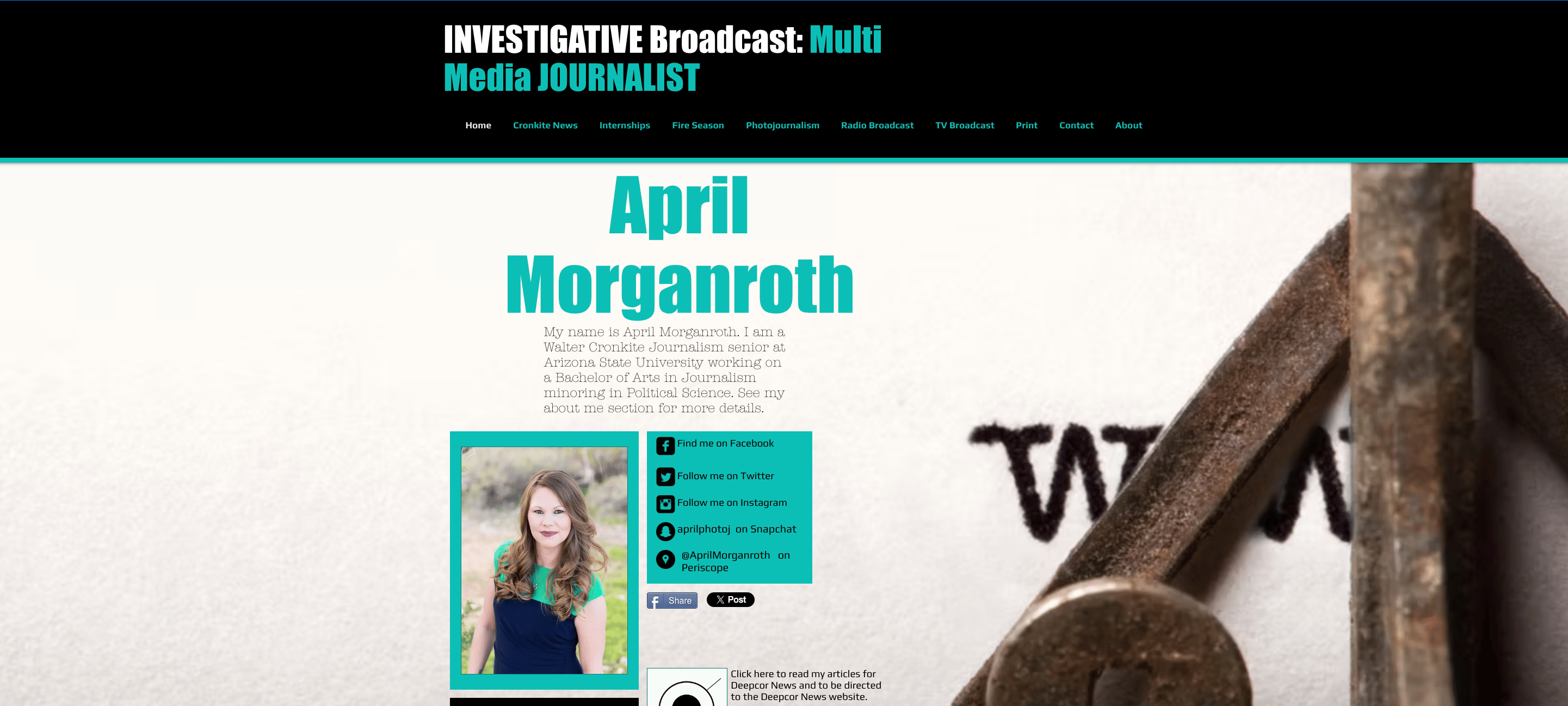
An American reporter, April Morganroth, is fired for fabricating quotes in a 9/11 anniversary story. She changes her name, moves to a new state, and starts over. Until 20 felony charges catch up with her in Wyoming.

Sacha Biazzo
10 aprile 2026
In partnership with

At Debrief, we often tell stories of people who assume different identities to get where they shouldn't be. Usually, they are journalists going undercover to reveal abuse and corruption. But this time the story is different. The journalist we're writing about today hid her true identity from her own newsroom, and the goal was not to uncover some hidden truth. April Marie Morganroth lived at least three professional lives, under three different names, across four American states, fabricating degrees and work experience, and even forging federal documents.
Her story was recently told by Sam Tabachnik in the Denver Post, in a lengthy and detailed investigation that pieced together Morganroth's entire trajectory across Arizona, Colorado, Nebraska, and Wyoming for the first time. Thanks to his work (and that of local Wyoming outlets like the Cowboy State Daily and WyoFile, which had been following the legal proceedings) we were able to put together the full picture of a journalist who for nearly two decades built and rebuilt false identities, getting away with it every time — until the next stop.
It's a fascinating story that shows how easily any system can be penetrated.
This issue is written by Sacha and edited by Luigi.
In This Issue of Debrief:
A career built on lies
April Morganroth's undercover story begins long before journalism. Born as April Marie McClellan in Arizona, she understood early on that cunning could get her past anyone. In 2007, at just 21, she managed to cash a $5,000 welfare check meant for her brother. According to court documents, she withdrew the money and disappeared. The following year, in 2008, while looking for a place to live, she forged a letter from the Department of Corrections to prove she worked there as an employee and fabricated a fake reference from her previous landlord. She was charged and found guilty of forgery, a felony in Arizona, and sentenced to probation.
After marrying Scott Morganroth, April changed her last name. She attended Phoenix College, where she earned an associate degree in digital photography in 2013, and enrolled at Arizona State University's Walter Cronkite School of Journalism. The university would later confirm that Morganroth had been enrolled but never completed any degree. Not the bachelor's, not the master's, and certainly not the PhD she would later claim under oath.
A friend from that period, Bethany Barnes, would tell the Denver Post that lies were a constant in Morganroth's life — full of stories about her family that turned out to be false and excuses for not going out that couldn't withstand the most basic scrutiny. Barnes described her as someone who "lied very well" and who "kept making herself look bigger than what was actually the case."

April Marie Morganroth | Platte County Jail
The 9/11 story that never existed
In 2020, Morganroth moved to Colorado with her husband and three children. She was hired by the joint newsroom of the Boulder Daily Camera and the Longmont Times-Call, publications owned by MediaNews Group. Something didn't add up on the résumé she submitted to get the job. She claimed nearly twenty years of journalism experience, even though she was only 35 at the time. She said she had worked as a full-time journalist for the Arizona Republic, but the staff directory from that period didn't include her name. She claimed to have graduated summa cum laude from the Cronkite School — but, as we've seen, she had never graduated at all.
On September 11, 2021, for the twentieth anniversary of the attacks, the Daily Camera published a front-page story by Morganroth featuring the testimonies of three Boulder residents affected by the tragedies of that day. One of them, a former naval intelligence analyst named Mark Pfundstein, was described watching Marines heroically rescue children from a nursery inside the Pentagon. A flight attendant was presented as a woman who was supposed to work on 9/11 but switched her shift at the last minute. A third subject, a mental health clinician, was portrayed in the anguish of not knowing whether his daughter was alive or dead.
The problem is that almost nothing Morganroth had written matched what the three people had actually told her. The quotes were fabricated. The facts were distorted. Pfundstein would later say he was "horrified" reading the article. Another of the subjects described the quotes attributed to him as "pure fiction." On October 1, 2021, the Daily Camera published a retraction nearly a thousand words long, in which the editors stated that the article "substantially misrepresented" the statements of the three sources and that "reliable transcripts of these interviews do not exist." Morganroth was fired. A colleague, courts and crime reporter Mitchell Byars, wrote on social media that there had been "frankly easily identifiable red flags" from the moment she was hired.
An incident like this should, in theory, have ended her journalism career. And yet.
Marie Hamilton, the journalist who never was
Instead, in 2022, a journalist named A. Marie Hamilton appeared on the editorial scene of southeast Wyoming. She worked for the Torrington Telegram, a small local paper near the Nebraska border. The following year, in April 2023, she was hired by the Sidney Sun-Telegraph in rural Nebraska. Her new editor, Barbara Perez, looked at her résumé in amazement. Multiple degrees from the Cronkite School, seventeen years of experience in the USA Today network, several statewide awards.
"We were all super excited," Perez would later recall. "Like, wow, why would someone with that much experience be here?" Before long, though, things didn't add up. Hamilton had problems with authority. She appeared to sometimes sleep in the office. Nobody ever met her husband, who she said was a regional manager for a local cable company. When Perez asked the company in question — which also happened to be an advertiser in the paper — they told her they had no idea what she was talking about. After four months, Hamilton resigned, telling colleagues that the Nebraska media company had offered her the editorship of a new paper in Cheyenne.
Of course, none of this was true.
Hamilton soon resurfaced at another Wyoming paper, the Platte County Record-Times. Her résumé had grown — she now boasted more than 25 years of experience. She wasn't even 40 yet. The paper announced she had worked for NPR and iHeartMedia. The Denver Post, which dug into her past, would find no trace of these positions. At Wyoming Press Association conventions, colleagues affectionately nicknamed her "Little Miss Fact-Checker" (a quasi-reference to the famous film Little Miss Sunshine) for her habit of chiming in with corrections during discussions.
When in August 2025 the News Media Corporation abruptly shut down dozens of local outlets — including eight in Wyoming — Hamilton became a champion of local journalism, working for free to keep the newsrooms open. The community organized a fundraiser for her. It was the peak of her career. Nobody suspected a thing.
Buoyed by this popularity, Hamilton founded her own outlet: the 307 Wyoming Sentinel, an "independent, community-centered" news organization based in Chugwater, a small town in southeast Wyoming. Its stated values: honesty, accuracy, ethical and watchdog journalism. Its motto: "Independent. Local. Unafraid."
But there is one detail that makes this story even more surreal.
On November 25, 2025, the Wyoming Sentinel published a 5,000-word article presented as an "investigation" into the alleged health risks caused by a wind and solar energy project. The article ran under the generic byline "Wyoming Sentinel Staff," as if it were the product of an entire newsroom. In reality, the Sentinel's website listed only one person: Marie Hamilton, who was simultaneously the owner, editor, and sole journalist of the outlet. There was no staff. And in the article, Hamilton cited as an expert source a certain "Marie Hamilton," presented in the third person as a children's disability rights advocate expressing her concerns about the impact of the energy project. In other words, the journalist who wrote the investigation, the editor who published it, and the expert source who supported it were all the same person. And none of the three actually existed.

April Morganroth | Southeast Wyoming Sentinel
The cover is blown
The house of cards built by April collapses precisely because of that energy project.
The Chugwater Energy Project is a large wind, solar, and battery storage facility. For rural Wyoming, it's a massive deal — estimated to generate roughly $180 million in tax revenue for Platte County over its operational lifetime. To be built, it must be approved by the Industrial Siting Council, a Wyoming state body that held a series of public hearings on the project between November and December 2025.
Hamilton did everything she could to stop it. She appeared before the council and testified under oath, presenting documents in support of her opposition, some of which she asked to be sealed, claiming they contained her children's confidential medical records.
In reality, those documents were fake. One was a ten-page letter attributed to a UCHealth physician, Dr. Aaron Meng, who no longer worked at that institution at the time the letter was supposedly written. The other two bore the logo of the Laramie County School District and were attributed to a teacher, Audrey Adams. Both, when contacted by investigators, denied having written a single word of those documents. NextEra's attorney flagged the suspected forgeries to the Wyoming Attorney General the very evening of the deposition. Hamilton promised the documents' supposed authors would call in to confirm. They never did.
But that's not all. In that same deposition, Hamilton reached the pinnacle of self-invented credentials. She declared under oath that she owned a property on JJ Road in Chugwater — which actually belonged to a family named Gillis. She claimed to hold three degrees from Arizona State. To be enrolled at the University of Wyoming's law school. To own a registered cattle brand. To operate ranching businesses across multiple states. She even introduced herself as "Dr. Marie Hamilton."
On March 9, 2026, prosecutors filed 10 felony charges: 3 for forgery, 3 for possession of forged documents, and 4 for perjury. She was arrested the following day.
Two weeks later, 10 more felony charges arrived in a parallel case. Investigators discovered that Morganroth had presented the Gillis family with a fake pre-approval letter for a $365,000 USDA federal loan to purchase the very same property she had already claimed to own. She had produced an award letter from a fictitious "Rural Communities Home Buyer Program" at the USDA — a program that does not exist. She had fabricated invoices from two construction companies — Cowgirl Demolition and Excavating and Pete's Builders Roofing — both of which confirmed they had never done any work for her. The owner of Cowgirl Demolition, looking at the fake invoice, said: "It was impressive. She used my logo, faded it with an image of an excavator, and had all the right wording. I asked myself: who is this person?"
The address listed on the USDA letters as the agency's office turned out to be an empty lot in Missouri. The phone number for the supposed USDA officer was an unreachable VoIP number. The loan program cited never existed. The deputy state director of USDA Rural Development, Janice Blare, confirmed there was no trace of the Morganroths in any of the agency's programs.
The theoretical maximum sentence for the 20 felony charges is 140 years in prison and $130,000 in fines.
There is an aspect of this story that goes beyond the individual criminal case.
Two journalism ethics experts interviewed by the Denver Post — Mark Feldstein of the University of Maryland and Bob Steele, former director of the Prindle Institute for Ethics at DePauw University — said they had never heard of a journalist who, after being caught fabricating stories, changed their identity to continue practicing the trade elsewhere. Feldstein called it a case "historically unprecedented in the modern era." He said he would have expected something like this from priests accused of pedophilia shuffled from parish to parish, or from doctors who move to another state after losing their license. But not from a journalist.
This story is also, inevitably, a story about the crisis of journalism. The small newsrooms where Morganroth operated were all chronically understaffed, often run by one or two people, unable to verify the credentials of new hires. In a landscape where local papers are closing by the dozens, anyone who shows up with an impressive résumé and a willingness to work for little finds open doors. The system is not built to defend itself against those who manipulate it from within.
Barbara Perez, the editor in Nebraska where April had worked, summed it up perfectly: "Part of me thinks she'll wiggle out of this one too. Getting out of things is kind of her forte. I'm popping some popcorn."
Until the next Debrief,
Sacha & Luigi
Smart starts here.

You don't have to read everything — just the right thing. 1440's daily newsletter distills the day's biggest stories from 100+ sources into one quick, 5-minute read. It's the fastest way to stay sharp, sound informed, and actually understand what's happening in the world. Join 4.5 million readers who start their day the smart way.
If you've come across an undercover investigation you think we should feature, share it with us here:
👉 https://forms.gle/1JbqMBJUfoRU9MBp7
If you have suggestions, questions, tips (or insults), drop us a line at:
👉 [email protected]
If you enjoyed this newsletter, pass it along to your friends using this link:
👉 https://debrief-newsletter.beehiiv.com/
Follow us on Instagram, occasionally we'll upload content different from the newsletter:
👉 https://www.instagram.com/debrief_undercover/
We've also launched a podcast featuring interviews with the authors of memorable undercover investigations:
👉 https://open.spotify.com/show
And if that's still not enough, join our Telegram channel, where we can keep the conversation going:
👉 https://t.me/debrief_undercover
Reply