- Debrief - The undercover dispatch
- Posts
- The undercover confession of an Israeli sniper who revealed his war crimes
The undercover confession of an Israeli sniper who revealed his war crimes
An independent documentary by a Palestinian journalist anticipated the mainstream Western media, exposing the perpetrators of crimes committed by the IDF.

Luigi Scarano
19 settembre 2025
Last Tuesday, September 16, the UN set a point of no return, perhaps belated, but unmistakable: what Israel is carrying out in Gaza is genocide. The Independent International Commission of Inquiry on the Occupied Palestinian Territory determined that the Israeli army and authorities have committed four of the five acts defined as genocidal under the 1948 Convention: killings, causing serious bodily or mental harm, inflicting living conditions aimed at destroying a people, and imposing measures intended to prevent births.
But if today the UN finally speaks out on what has been happening in Gaza daily for almost two years, it is thanks to Palestinian journalists who have been documenting it since the very beginning of the war. Videos, testimonies, and evidence gathered on the ground have shown how unarmed civilians were targeted and killed, how homes, hospitals, and schools were deliberately bombed and reduced to rubble, and how the siege of the Strip has been turned into a systematic weapon of starvation and annihilation. It is within this picture, made of denied yet increasingly undeniable crimes, that the case we highlight today emerges: while the Israeli army kept proclaiming itself “the most ethical in the world,” operating “in full compliance with the rules of engagement and international law,” a Palestinian journalist, using undercover methods, managed to make an IDF sniper confess to a war crime.
If these issues matter to you, next week, from September 24 to 28, the international investigative journalism festival DIG 2025 will take place in Modena, Italy. Among the many highlights of the program, there will be a screening of investigative films and documentaries on Gaza. As for us, unsurprisingly, we’ll be talking about undercover journalism alongside some excellent colleagues.
This issue is written by Luigi and edited by Sacha.
In This Issue of Debrief:
The “Ghosts” of Tal al-Hawa
On the morning of November 22, 2023, in the Tal al-Hawa neighborhood south of Gaza City, 26-year-old Mohammed Doghmosh was walking with his cousin Youssef, not far from the Al Jalil secondary school, where dozens of families had taken refuge. Only a few weeks had passed since the start of Israel’s offensive in Gaza, but the streets around them were already reduced to rubble.
Mohammed and Youssef crossed the street. A shot rang out from a distance, its source unclear. It struck Mohammed, who collapsed instantly, motionless. Youssef ran for cover. Salem, Mohammed’s 19-year-old brother, rushed toward his body. He tried to drag him away, but a bullet hit him in the head. He fell beside his brother. Their father, 51-year-old Montasser, dashed into the street shouting, “My boys!” He too was shot, gravely wounded but still alive. A nephew, Khalil, tried to rescue him. He managed to pull him a few steps before another round hit. Khalil was injured, but survived. That day cost the Doghmosh family four lives. Two more were wounded. The brothers’ bodies lay in the street until the ceasefire on November 24. No one dared to approach: “Anyone who tried was shot,” Khalil later said.
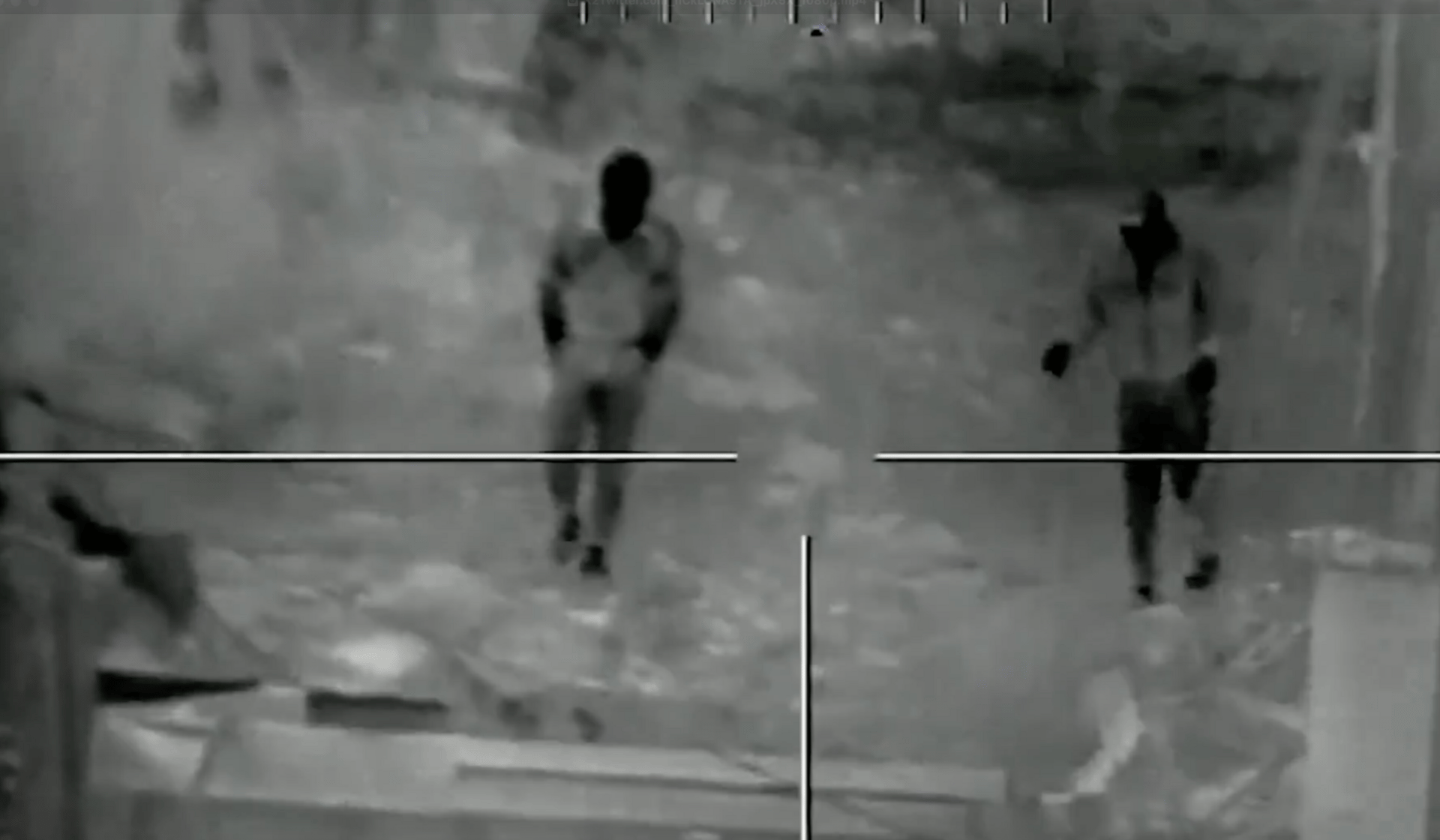
Footage captured by the IDF’s thermal cameras
Roughly 300 meters away, inside a six-story building at the end of Moneer Al Rayyes Street, directly facing the Barcelona Garden park, two snipers from the IDF’s Paratroopers Battalion 202 sat on a wicker sofa, their precision rifles at the ready. Their squad’s code name was “Refaim,” the Hebrew word for “ghosts.”
(Undercover) Confessions of a Sniper
The killers of the Doghmosh family would never have had a face if the very Israeli soldiers who committed the crime had not provided the evidence themselves. In April 2024, a sniper named Shalom Gilbert, a member of the “Ghosts” from Battalion 202, uploaded a seven-minute video to YouTube showing combat scenes in Gaza: unarmed Palestinian civilians collapsing under fire, bodies left on the roadside like trash, Israeli troops advancing through the rubble, all set to an action-movie soundtrack. Among the clips published by Gilbert was also the massacre of Mohammed, Salem, and Montasser Doghmosh, filmed with IDF drones and thermal cameras.
The video, uploaded to celebrate that mission in Gaza, was taken down from YouTube months later, but copies had already been saved. One of those who preserved it was Palestinian journalist Younis Tirawi, who launched his own investigation based in part on those images. By cross-referencing satellite footage, photos and videos from soldiers’ social media profiles, and Gilbert’s material, Tirawi was able to identify the two snipers: Daniel Raab, an American from Illinois, and Daniel Graetz, a German from Munich, both enlisted in the IDF.
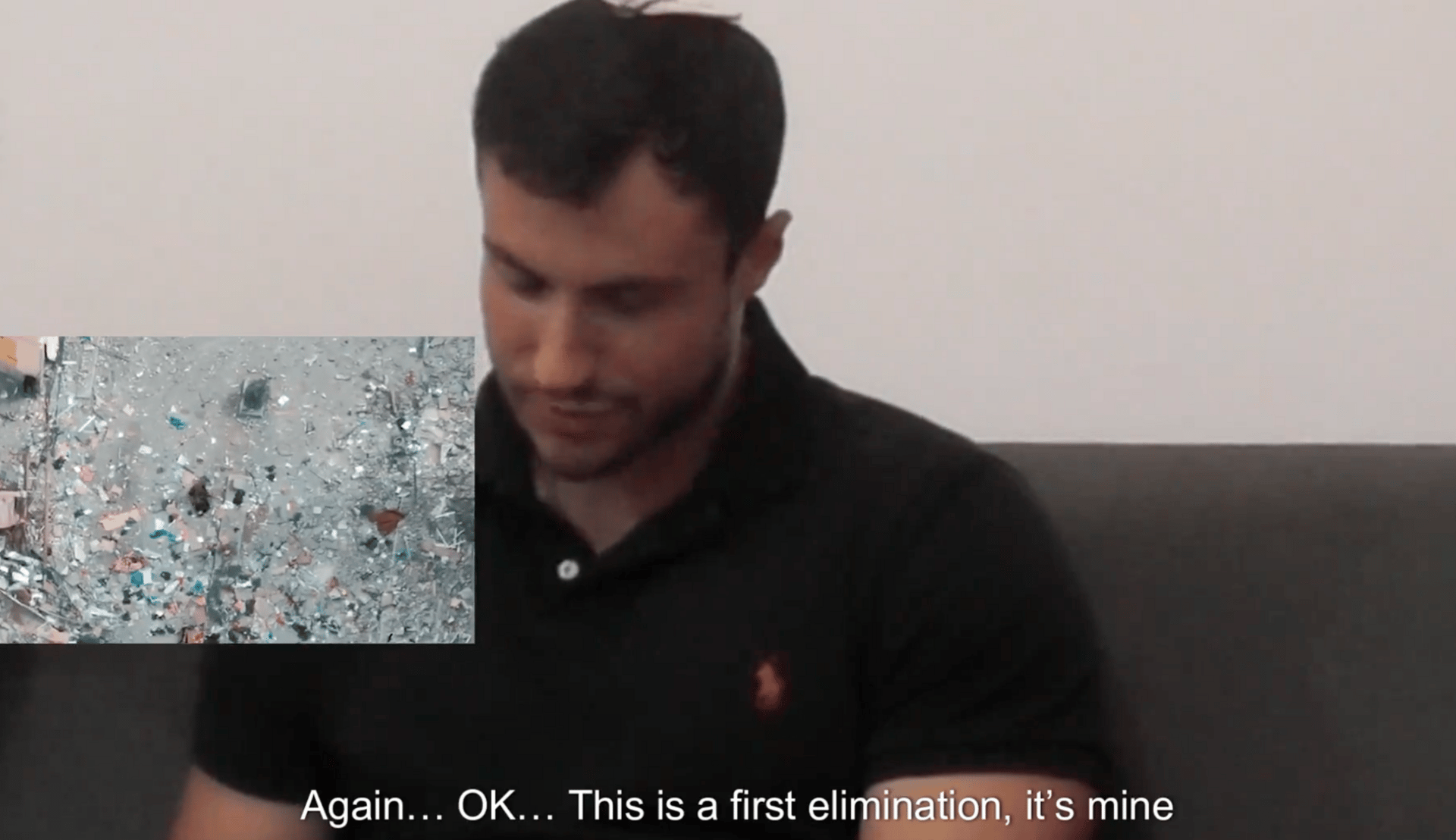
Seeking further confirmation, Tirawi decided to ask the perpetrators directly. In the summer of 2024, he approached Sergeant Daniel Raab with the help of a Hebrew-speaking colleague posing as a young Israeli eager to recount the heroic exploits of paratroopers and fallen soldiers. Raab eagerly agreed, on the condition that his face be obscured, and spent hours speaking with startling candor. He appeared perfectly at ease while incriminating both himself and his comrade Graetz for the Doghmosh family massacre.
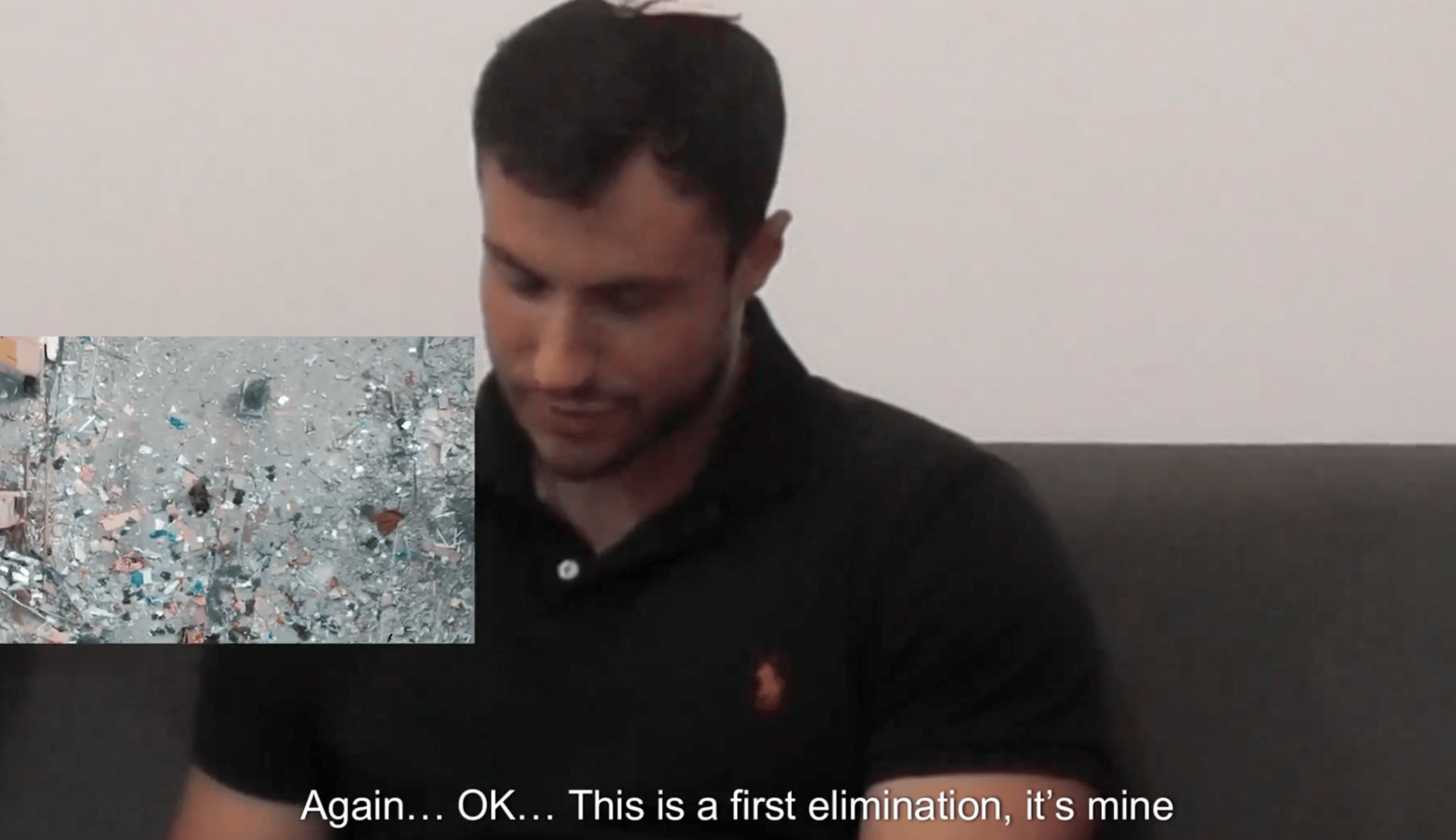
Daniel Raab confessing the killing, from Younis Tirawi’s documentary
During the undercover interview, shown footage from the operation uploaded to YouTube, Sergeant Raab recalled the death of 19-year-old Salem Doghmosh, shot in the head: “That was my first elimination,” he said casually. Drone footage showed the unarmed young Palestinian collapsing beside his already-dead brother; Raab admitted to firing knowing Salem was unarmed. The boys’ father, Montasser Doghmosh, who had rushed desperately to recover his sons’ bodies, was also gunned down. In the undercover exchange, Raab expressed no remorse for his actions, on the contrary, he mocked the victims’ displays of compassion. Killing anyone who crossed the “imaginary line” around the corpses, including family members trying to recover their loved ones, was part of their task: “They kept coming to try to take away those bodies… that’s why snipers exist,” he declared cynically. Throughout the campaign, Raab confessed, his squad had eliminated at least 120 people, a tally he considered “impressive.” He also proudly highlighted a particular unit record: a kill at over 1,200 meters, essentially a marksmanship contest among comrades, complete with a running scoreboard.
Once Tirawi had secured the recordings (over 160 minutes of footage across nine clips, plus an audio-recorded phone call with Raab) he chose to release the most incriminating parts. In October 2024, he published a 40-minute investigative documentary that revealed to the public the existence of the so-called “Ghost Unit” of IDF snipers, featuring excerpts from the interview with Sergeant Raab alongside other harrowing details of civilian killings in Gaza.
From Western Suburbs to the Rooftops of Gaza
In 2025, an international team of investigative journalists, including The Guardian, ARIJ, Der Spiegel, and ZDF, carried out a five-month investigation that expanded on and gave further visibility to Tirawi’s work. Through interviews with witnesses and video analysis, the inquiry reconstructed the precise sequence of events of November 22, 2023. In the building where Raab and Graetz had been positioned, a reporter found graffiti left by the unit, including a large number 9 with devil horns and a tail, the logo used by the “Ghost Unit” snipers during the campaign. The follow-up investigation, published just last week on September 9, gave the Doghmosh case global resonance.
What the cross-border investigation really adds to what Younis Tirawi had already documented in 2024 is a profile of the two soldiers: two young men raised in the West, far from war, who chose to enlist in the IDF and ended up in the same sniper unit. Daniel Raab grew up in Naperville, a wealthy suburb of Chicago, Illinois. A former molecular biology student and basketball player, he was president of Illini Students Supporting Israel in the U.S. and a student leader in the Jewish organization Chabad. His life took a different turn when he decided to move to Israel and voluntarily enlist in the IDF paratroopers. Daniel Graetz, by contrast, was born and raised in Munich. After moving to Israel at a young age, he acquired dual citizenship and also joined the same battalion. Within the squad, he was nicknamed “Santa,” a moniker that appeared in the soldiers’ private chats.

Il logo dello squadrone dei “fantasmi”
Following the release of the material, the Council on American-Islamic Relations (CAIR) called on the U.S. Department of Justice to investigate Raab for war crimes, while the European Center for Constitutional and Human Rights (ECCHR) filed a criminal complaint in Germany, demanding that Graetz’s actions be prosecuted.
“The First Livestreamed Genocide in History”
The undercover operation coordinated by Tirawi is part of a broader current of journalistic investigations that have documented war crimes admitted to, or even flaunted by, Israeli soldiers themselves. One of the most striking examples is Investigating War Crimes in Gaza, a documentary produced by Al Jazeera’s Investigative Unit and released in October 2024, around the same time as Tirawi’s exposé. The film revealed numerous violations committed by the IDF through the very videos and photos soldiers shared on social media during the Gaza campaign.
The material is chilling: footage of homes in Gaza being looted and destroyed, prisoners abused, and even civilians executed, often presented in a joking or celebratory tone. The sheer volume of evidence provided by the soldiers themselves led Palestinian writer Susan Abulhawa to describe this war as “the first livestreamed genocide in history.”
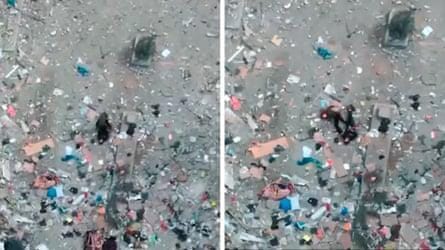
The outcome of the Doghmosh massacre
And yet, Tirawi’s work was initially met with skepticism. To preempt accusations of manipulation, Der Spiegel commissioned a forensic institute to analyze the video interviews with Raab; the institute confirmed that the sergeant’s words in Tirawi’s documentary had not been altered. Only after this technical verification, and the subsequent publications by The Guardian and ZDF, did the investigation gain full international legitimacy. But the evidence had been there months earlier, gathered by an independent Palestinian journalist who publishes everything he uncovers directly on his X account, with no newsroom to shield him. And above all, who did not hesitate to do what every journalist should: use every available tool to verify and make public a story, and to restore things to their proper name. In this case: a war crime.
Until the next Debrief,
Sacha & Luigi
If you've come across an undercover investigation you think we should feature, share it with us here:
👉 https://forms.gle/1JbqMBJUfoRU9MBp7
If you have suggestions, questions, tips (or insults), drop us a line at:
👉 [email protected]
If you enjoyed this newsletter, pass it along to your friends using this link:
👉 https://debrief-newsletter.beehiiv.com/
Follow us on Instagram, occasionally we'll upload content different from the newsletter:
👉 https://www.instagram.com/debrief_undercover/
We've also launched a podcast featuring interviews with the authors of memorable undercover investigations:
👉 https://open.spotify.com/show
And if that's still not enough, join our Telegram channel, where we can keep the conversation going:
👉 https://t.me/debrief_undercover
Reply