- Debrief - The undercover dispatch
- Posts
- Undercover in the Police to Expose Its Abuses
Undercover in the Police to Expose Its Abuses
BBC journalist Rory Bibb went undercover for seven months inside London’s police force to document racism, sexism, and abuse of power.

Luigi Scarano
7 novembre 2025

There’s a paradox that undercover journalism often stumbles into: the more impenetrable a place seems, the more necessary it becomes to enter it. Not out of curiosity, but in the public interest, because what happens behind those walls escapes all collective oversight. And so, when one of the oldest and most renowned police forces in the world piles up accusations of racism, sexism, violence, and corruption, it becomes inevitable for a journalist to try to see what’s happening from the inside.
That’s exactly what happened in the United Kingdom, where the newsroom of Panorama, the BBC’s flagship investigative program, sent a young reporter undercover inside the Met, London’s Metropolitan Police, for seven months. Hired as a civilian staff member at Charing Cross station, one of the most controversial in the capital, he recorded insults, and violent, sexist language that expose a rotten internal culture, one in which abuse is anything but an exception.
This issue is written by Luigi and edited by Sacha.
In This Issue of Debrief:
The Last Place on Earth to Hide a Camera
“Are you wearing a wire?” PC Phil Neilson sits at a pub table, around thirty years old, dressed in a black polo shirt. As he speaks, he gestures toward the young man sitting across from him, sharing a beer. Behind him, mounted on a brick wall, a red neon sign glows: BAD DECISIONS. Neilson studies the young man with an unreadable expression, then asks if he works for the Directorate of Professional Standards (DPS) of the Met, the unit responsible for internal investigations within the police. He then grins, raises his hand to his ear as if holding a phone, and says: “I'm getting this is a sting. This is DPS. This is DPS trying to catch me out, or something.” The two burst out laughing.

The Pub Meeting with Phil Neilson | BBC
Neilson’s suspicion was more than justified. The young man sitting across from him, Rory Bibb, who had worn the Metropolitan Police uniform for seven months, was in fact a BBC journalist, and he was secretly filming everything, including that very conversation. For weeks, Bibb worked side by side with officers during night shifts, shared coffee breaks, and even struck up friendships with some of them, including Neilson.
To everyone, Bibb was a new civilian detention officer at Charing Cross police station, in the heart of London, and that was technically true. But while doing that job, he was also doing another. With a concealed camera, he recorded dozens upon dozens of hours of conversations and incidents that laid bare, in all their everyday banality, what had long been suspected about the Met: an internal culture marked by racism, misogyny, and abuse of power. The investigation, Undercover in the Police, aired on BBC Panorama on October 1, began with a question as simple as it was unsettling: how much of what the police claim to fight still thrives within their own ranks?
Rory Bibb Working Inside the Met | BBC
“It's literally the last place on earth you'd want to be wearing secret cameras,” Bibb told his BBC Panorama colleague Emma Vardy, with whom — alongside director Joe Plomin and producers Adrian Polglase and Alice Crinnigan — he delivered the investigation. To end up in that position, Bibb submitted an online job application using his real credentials: a 28-year-old journalism graduate who had worked for a time in public relations. With the only precaution of omitting that he was currently working for Panorama, he passed the security vetting process. After an interview, he was hired at Charing Cross police station, tasked with ensuring that detainees were fed, given water, and kept in safe conditions.
In that role, the reporter had daily access to the custody suite, where detainees are held, and was in close contact with officers and sergeants. His goal was to document misconduct within the ranks, as had been alleged in numerous past complaints. In footage captured by his hidden camera, a sergeant with twenty years of service, Joe McIlvenny, is shown mocking and downplaying a serious allegation of sexual violence. When asked why he had released on bail a man accused of raping and assaulting his pregnant partner, the sergeant shrugged and said, “That’s what she says,” casting doubt on the victim’s account.
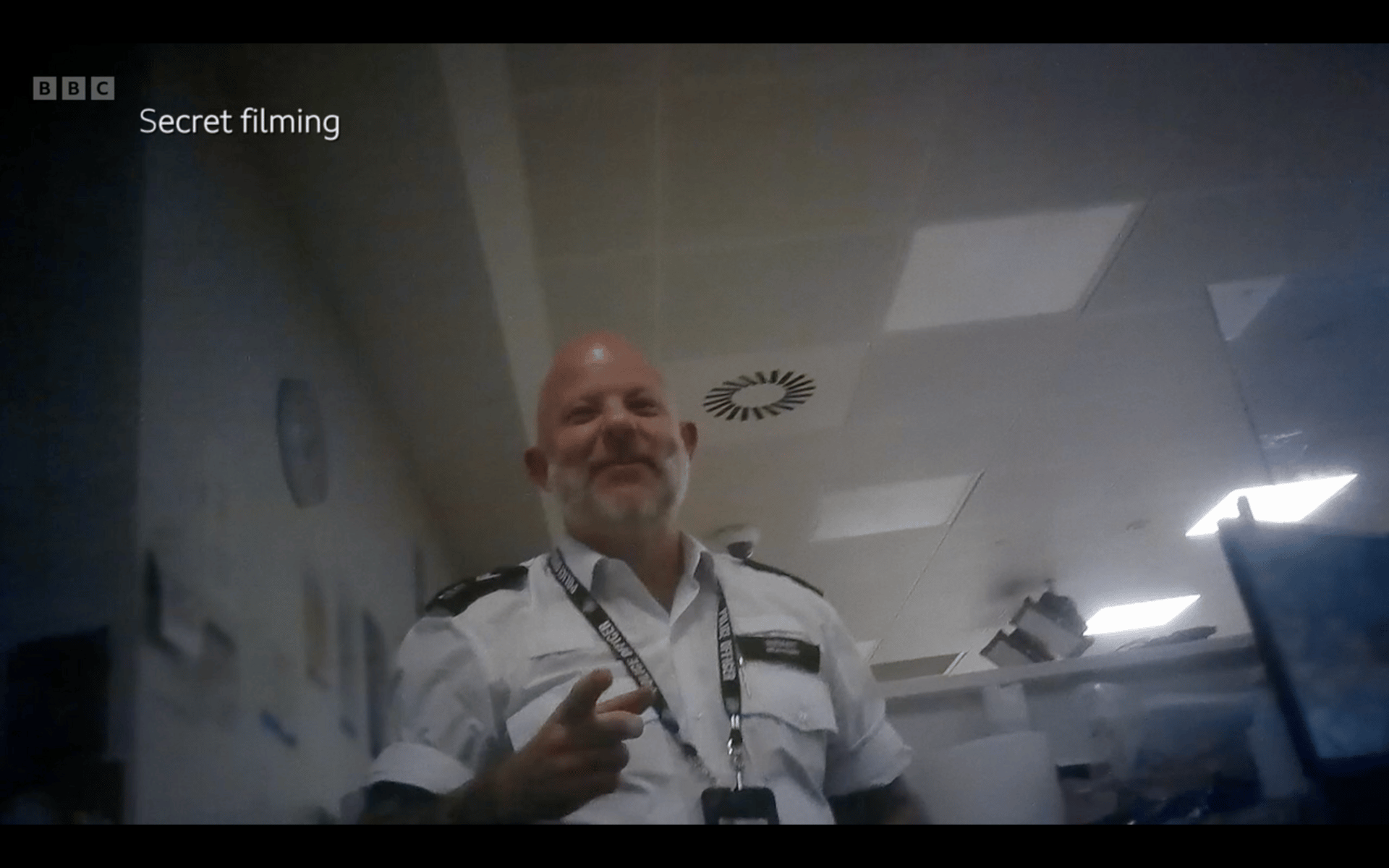
Sergeant Joe McIlvenny | BBC
In another recording, officers on duty in the custody suite speak with contempt about foreigners and members of ethnic minorities. One said that a detainee from North Africa deserved “a bullet through his head.” Others referred to migrants from countries such as Algeria or Somalia as “scum.” Islamophobic remarks, wrapped in a casual, xenophobic vernacular, were a routine occurrence.
Several clips show officers boasting about the use of excessive force. One officer is caught laughing as he brags to a colleague about beating a detainee: “I whacked the shit out of the back of his legs,” he says, smiling, describing how he struck a handcuffed prisoner. He even boasted that he had never received a complaint, then mimics, mockingly, someone accusing the police of brutality. Although the officer later claimed he had exaggerated as a joke and had not actually assaulted the detainee to that extent, the mere glorification of gratuitous violence was seen as symptomatic of a toxic culture, and cost him his job. In another incident, officers discuss how to rough up a suspect and then falsify reports to cover up their use of excessive force, taking care not to talk about it in front of the station’s surveillance cameras.
The “Prima Facie” Evidence and the Case of the Met Police
According to the BBC’s editorial guidelines, the use of undercover methods is permitted only when there is strong preliminary evidence indicating that wrongdoing or an issue of significant public interest is taking place or is about to take place. This is known as the prima facie evidence, literally “at first sight”, and it represents the minimum threshold that must be met before authorizing any form of secret recording. The more an investigation risks invading privacy, the stronger the justification must be.
In the case of the investigation into the Metropolitan Police, these conditions were met. The undercover operation was launched after decades of scandals and allegations involving the Met. In 1999, the Macpherson Report, which followed the racist murder of Stephen Lawrence and the police’s botched investigation, concluded that the Met was afflicted by “institutional racism.” Despite some reforms in the years that followed, controversial incidents continued to erode public trust in London’s police force.

Charing Cross Police Station | BBC
From 2020 onwards, a succession of cases and inquiries exposed deep-seated misogyny, racism, and corruption within the Met. In March 2021, the murder of Sarah Everard, a young woman kidnapped and killed by serving Met officer Wayne Couzens, shook the country and raised serious questions about the force’s sexist culture and internal oversight. Only months later, shocking messages exchanged between officers at Charing Cross station, the very same one featured in the BBC investigation, came to light. A 2022 report by the Independent Office for Police Conduct revealed chat logs filled with racist slurs, jokes about rape and violence against women, and a normalization of hate speech. The scandal led to the resignation of then–Commissioner Cressida Dick and prompted the Met’s leadership to pledge “zero tolerance” toward such behavior.
In 2023, an in-depth independent review led by Baroness Louise Casey painted an alarming picture. The Casey Report concluded that the Metropolitan Police is institutionally racist, misogynistic, and homophobic, highlighting systemic problems of culture and management. While acknowledging the report’s findings on cultural decay, the new Commissioner, Sir Mark Rowley, who took office in 2022, initially rejected the term “institutional” when referring to racism and sexism, arguing that the majority of officers are “good people” and that the issues stem from a minority of bad actors and procedural failures. Around the same time, the case of David Carrick, a Met officer convicted in 2023 of dozens of rapes and sexual assaults committed over years of service, further reinforced the perception of rampant, unchecked misogyny within the force.
Beyond racism and sexism, the Met has also faced accusations of institutional corruption. In 2021, an independent panel investigating the unsolved murder of private investigatorDaniel Morgan accused the Met of being “institutionally corrupt”, more concerned with protecting its reputation than uncovering the truth. Taken together, these precedents made the BBC’s infiltration not only justified, but necessary.
How the BBC Investigation Shook the United Kingdom
The broadcast of the BBC investigation sent shockwaves through the UK media landscape. National outlets across the political spectrum devoted extensive coverage to the story, often with alarmed tones over the growing crisis of trust in the police. The Guardian, for instance, ran the headline that the Met had “plunged into crisis” over the new allegations, reporting concerns at the highest levels that the revelations could “damage confidence in the force and cast doubt on claims it is reforming radically enough after years of scandal.” The paper also noted that even within the Met, some senior officers, such as Andy George, president of the National Black Police Association (NBPA), publicly stated that the force should be dismantled and rebuilt from scratch.
The revelations prompted swift and forceful reactions at the highest political and institutional levels in the UK. Prime Minister Keir Starmer called the findings “shocking” and demanded a “strong and decisive” response from the leadership of the Metropolitan Police. Starmer, who had been opposition leader during previous Met scandals, emphasized that public trust must be a priority and that such behavior must have consequences. Similarly, the newly appointed Home Secretary Shabana Mahmood, responsible for police forces nationwide, described the footage shown in the investigation as “disturbing” and “sickening,” voicing full support for a rapid and thorough inquiry by the Independent Office for Police Conduct (IOPC).

Another Scene from “Undercover in the Police” | BBC
At the local level, London Mayor Sadiq Khan, whose office oversees the Met through the Mayor’s Office for Policing and Crime, called the BBC documentary deeply disturbing and announced that he would accelerate the launch of an independent follow-up review of the Met. The London Assembly’s Police and Crime Committee, through its chair Marina Ahmad, stated that “last night’s BBC1 Panorama programme will have sent a chill through the spine of any law-abiding Londoner.” She added that “what appears to have been common practice at Charing Cross Police Station is shocking,” and said that the Committee “will be asking some tough questions when the Met appears before us at our meeting on October 16th.” Ahmad pledged that the Assembly would do its part to hold the force accountable and ensure such a situation could never arise again.
The Met Police leadership reacted publicly the same evening the program aired. Commissioner Sir Mark Rowley issued a lengthy official statement apologizing to citizens and announcing immediate action. Rowley revealed that within 48 hours of receiving the BBC’s allegations, the Met had suspended nine officers and one civilian employee, and removed two additional officers from operational duties. The entire Charing Cross custody team was immediately disbanded. All 34 civilian detention officers at the station were reassigned to other locations, and the 16 sergeants responsible for its cells were redeployed to new roles. Rowley also announced a comprehensive review of all custody units within the Met to identify other pockets of toxic culture and remove problematic leaders or teams.
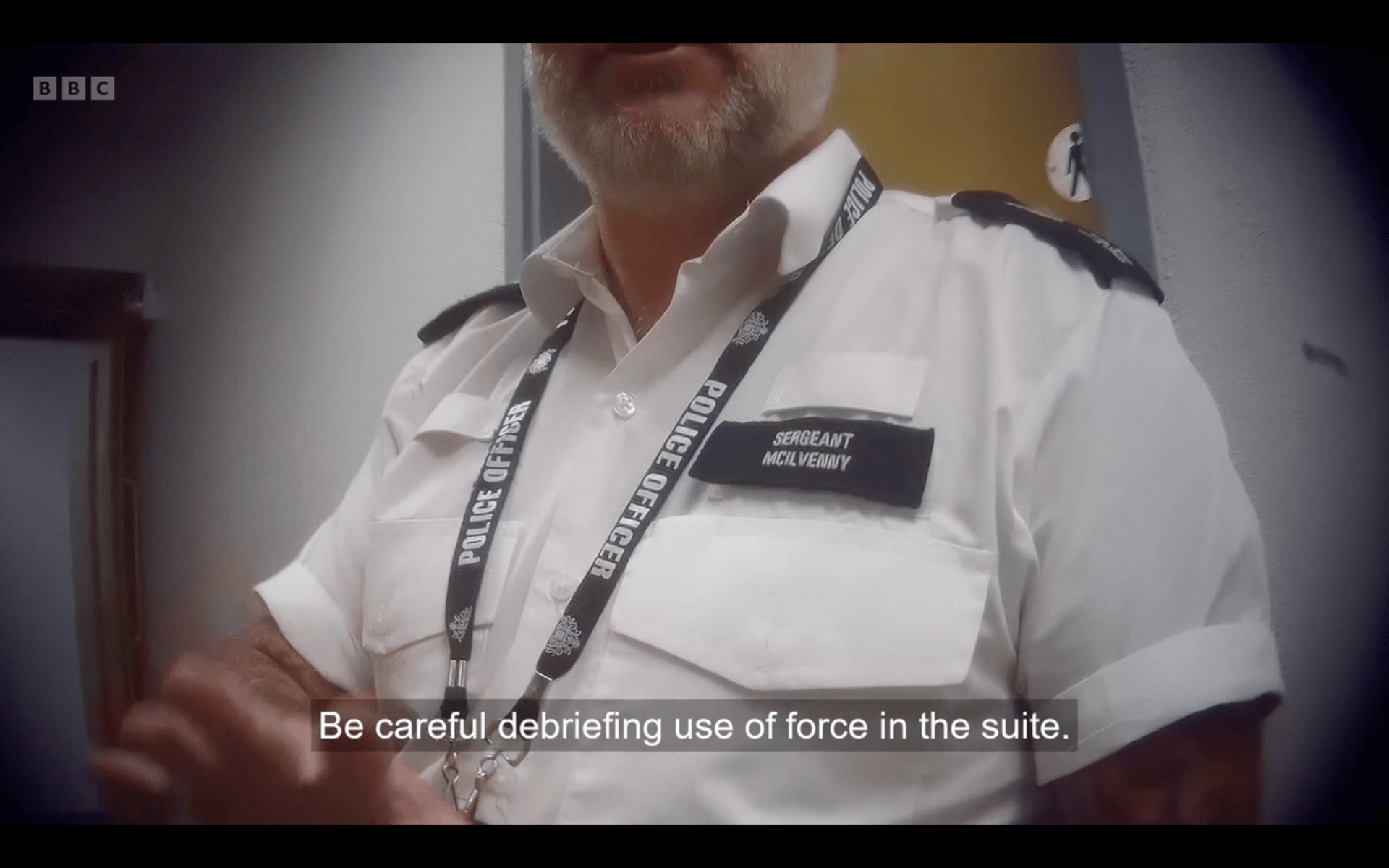
Secrecy Required | BBC
Undercover in the Police is not just an exposé of the Met, it is a demonstration of the power of investigative journalism, and undercover reporting in particular. The BBC investigation doesn’t merely expose a corrupt police force; it lays bare the collapse of an entire oversight system that allowed an institution created to uphold the law to repeatedly break it. And it reminds us that when institutional transparency fails completely, truth must be sought by other means.
Until next Debrief,
Sacha and Luigi
If you've come across an undercover investigation you think we should feature, share it with us here:
👉 https://forms.gle/1JbqMBJUfoRU9MBp7
If you have suggestions, questions, tips (or insults), drop us a line at:
👉 [email protected]
If you enjoyed this newsletter, pass it along to your friends using this link:
👉 https://debrief-newsletter.beehiiv.com/
Follow us on Instagram, occasionally we'll upload content different from the newsletter:
👉 https://www.instagram.com/debrief_undercover/
We've also launched a podcast featuring interviews with the authors of memorable undercover investigations:
👉 https://open.spotify.com/show
And if that's still not enough, join our Telegram channel, where we can keep the conversation going:
👉 https://t.me/debrief_undercover
Reply