- Debrief - The undercover dispatch
- Posts
- Undercover inside the jihad: six months among terrorists during the Bataclan
Undercover inside the jihad: six months among terrorists during the Bataclan
How a French journalist, infiltrated among ISIS jihadists, exposed the existence of a cell preparing to strike again.

Luigi Scarano
14 novembre 2025

In partnership with

Yesterday, November 13, marked the tenth anniversary of one of the deadliest attacks in recent European history. That night, a series of coordinated strikes hit the heart of Paris: gunfire in cafés and restaurants, explosions at the Stade de France, and, above all, the massacre at the Bataclan theater, where 90 people were killed during a concert. By the end of the night, 130 people had been killed and 416 wounded.
Ten months earlier, on January 7, 2015, the newsroom of the satirical newspaper Charlie Hebdo had been attacked, leaving 20 dead. Fear spread across France and Europe, fear of an internal enemy: European citizens radicalizing in silence, behind bedroom doors or inside encrypted chats, ready to kill and die in the name of Daesh, the self-proclaimed Islamist state.
In May 2016, Canal+ broadcast an investigation that would leave a lasting mark: Les Soldats d’Allah. An unprecedented undercover documentary in which a French journalist managed to infiltrate a jihadist cell for six months, a group with direct links to senior Islamic State leadership in Syria. The group was preparing to strike, planning an attack on French soil, this time in front of Notre-Dame Cathedral.
But Les Soldats d’Allah is above all the story of an extraordinary journalistic infiltration, in which the reporter used multiple identities, risked his life, and has lived anonymously ever since.
This issue is written by Luigi and edited by Sacha.
In This Issue of Debrief:
Letter for a massacre: the proof of the Invisible Emir
December 2015, Paris. Abou Hamza is about thirty years old, a second-generation Frenchman, Muslim, moderately religious, raised in a family of North African origin in the suburbs of Paris. One day, he receives a message. The sender is a man named Abou Souleyman, someone his age whom he met online a few weeks earlier. Souleyman told him he had been in Raqqa, Syria, at that time considered the capital of Daesh, the self-proclaimed Islamist state, but had returned to Paris a few months earlier.
Souleyman calls himself “the Invisible Emir.” In the message, he tells Hamza that he wants to meet him in person, giving him an appointment at the Saint-Denis train station. When Hamza arrives, he scans the crowd but can’t spot anyone resembling the few photos he has seen of Souleyman. Instead, a small young woman wearing a black niqab approaches him, revealing only a very young face; in her hands she carries a yellow envelope, the kind used for postal packages. She hands it to him and walks away.
The delivery of the letter at the station | Canal+
Inside the envelope is a letter, handwritten in black ink, rounded handwriting on graph paper. Its contents are chilling. Inside the letter, Abou Hamza finds the instructions for an operation to be carried out in France. The author is Souleyman: he wants an attack to take place in a nightclub in Paris, it must happen in a popular place full of “disgusting, evil unbelievers.” One or two suicide bombers must detonate themselves inside, while the others wait outside to kill the remaining “impure meat.” They are to stay hidden until the police and soldiers arrive, and then attack them as well. It will be a slaughter.
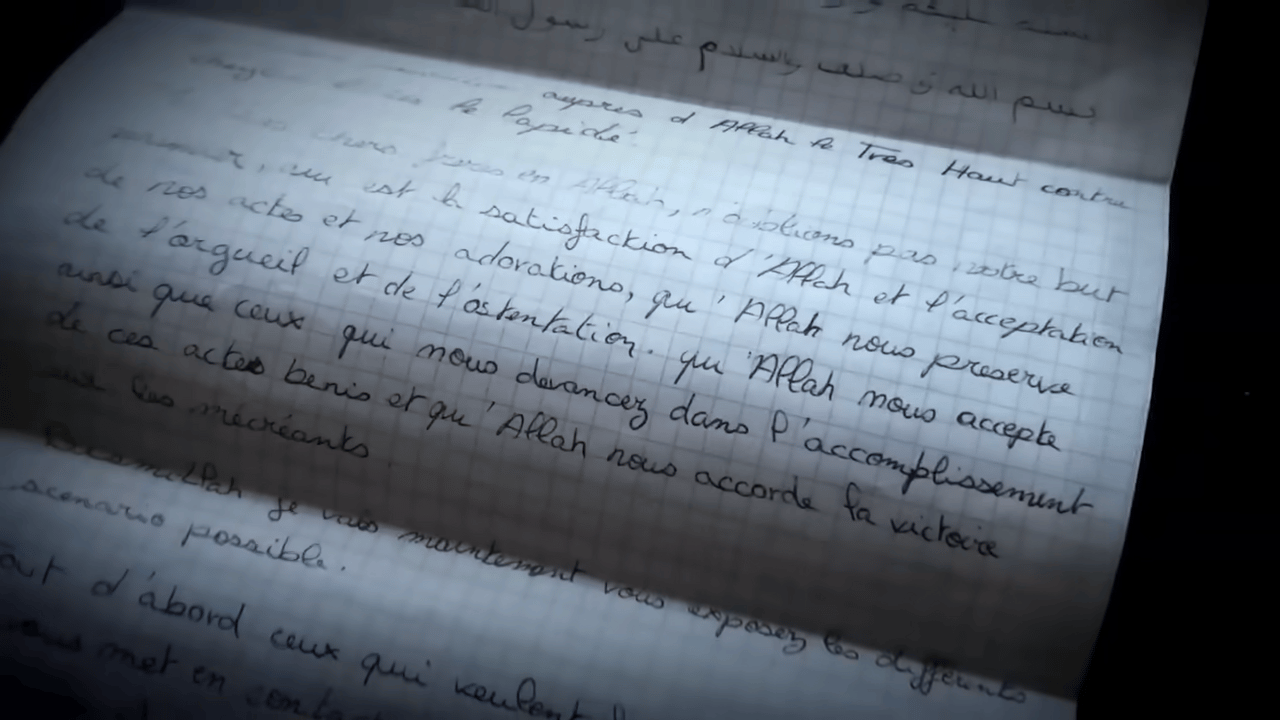
The contents of the yellow envelope | Canal+
According to the instructions, Hamza must read the letter and then destroy it, and finally convey its contents to another young man, younger than him, named Abou Oussama, whom Hamza has known for several months. When Hamza meets Oussama to tell him everything, the boy finishes his sentences and nods. At that point Hamza understands everything: it was a test to verify his reliability, and the good news is that he has just passed it. But the bad news is that this very reliability could now become a huge problem. Because Abou Hamza is not a terrorist at all, he is an investigative journalist. For months he has been infiltrated inside this terrorist cell, recording everything with a hidden camera.
Inside the cell: six months with the Soldiers of Allah
This story begins almost a year earlier, on January 7, 2015, with the attack on Charlie Hebdo. That moment pushes the reporter to try to understand how it is possible for young French men to become so radicalized that they are willing to die in the name of a religious fanaticism that has very little to do with Islam. He begins spending weeks in several Salafi mosques considered by both the media and intelligence services to be “environments at risk of radicalization.” But during those weeks of prayer, he discovers something entirely different: the people he meets warn him against Daesh, which they see as a cult, and describe jihadists as violent heretics.
At that point, the journalist creates a Facebook profile under the alias Abou Hamza and joins groups such as “Un livre qui guide et une épée qui secourt” (“A Book That Guides and a Sword That Rescues”) and “Les Lions du Tawhid” (“The Lions of Tawhid”, tawhid is the principle of the oneness of God in Islam). He is added by several accounts and soon invited into a Telegram group. The app had just exploded in popularity among jihadist circles, prized for its security features and for the fact that, under French law, it was extremely difficult for counterterrorism units to infiltrate or trace encrypted chats.
Members of the cell, who call themselves “Les Soldats d’Allah” (the Soldiers of Allah), invite Hamza to meet in person. In the car, they listen to nasheed repurposed by Daesh as war anthems. When they gather, they watch propaganda videos, beheadings, and tutorials on how to build improvised bombs. The group is young, but many are already known to the police: among them is Abou Oussama, their very young leader, with a terrorism record and under surveillance at the time.
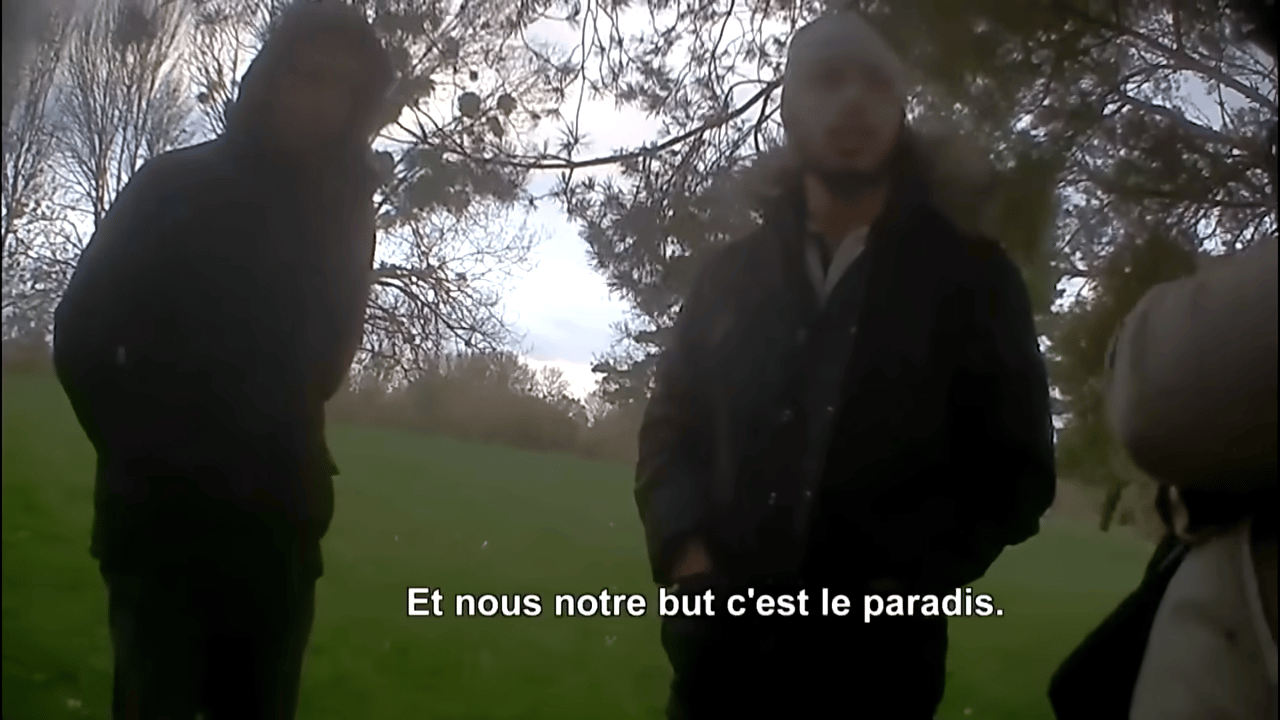
Abou Oussama with several members of the “Soldiers of Allah” | Canal+
Oussama is just twenty years old and carries a chaotic personal history. His mother is French, his father Turkish, and his parents are separated. At fourteen he becomes interested in Satanism. At sixteen he tries to enlist in the French army but is rejected because of a vision problem. After that he falls into a depressive spiral of alcohol and isolation, until he encounters radical Islam, reaching it, as he himself admits, through a conspiracy video produced by the American evangelical far right. According to his father, the original wound was that rejection by the army: Oussama felt discarded by France, seen as neither French nor Turkish, essentially an outcast.
In 2014, his father reports him to the police fearing he intends to leave for Syria. And indeed, shortly afterward, Oussama tries: he takes a flight from Lyon to Turkey to join Daesh, but Turkish authorities, alerted by the French, send him back. He tells the police he wants to die a martyr. French authorities describe Oussama as “fragile, detached from reality, potentially dangerous.” In February 2015 he is arrested and imprisoned in Fresnes, where he meets other Islamists and becomes even more radicalized. After five months, he convinces officers that his extremist beliefs have faded: he is released and placed under surveillance.

Oussama says: “I want to see thousands of French people die.” | Canal+
When he meets Hamza, he boasts that he has deceived everyone. It is Taqiyya, the practice of concealing one’s faith to avoid detection. In front of his father he becomes affectionate again, shaves his beard, and spends more time with his family. But in private he still dreams of martyrdom. Psychologist Fethi Benslama, an expert on radicalization, explains that people like Oussama, marked by depression and a sense of worthlessness, perceive themselves as “garbage” and seek to fill that void with something extreme: “Radicalization is one possible path, a way to ennoble a homicidal impulse.”
In October 2015, a new member arrives from Raqqa: Abou Souleyman, the Invisible Emir. Oussama takes orders from him. The two mean business. Souleyman, through the same young woman in a niqab, delivers the first assignment to Hamza. Hamza is also asked to travel to Orléans to retrieve weapons. On November 13, 2015, the day of the Bataclan attack, the group celebrates the deaths scattered across Parisian streets and venues. Oussama urges them to repeat Charlie Hebdo and spill more blood. But on December 27, 2015, at five in the morning, the police raid Oussama’s home and arrest him. Soon, the other members of the cell are rounded up as well.
Souleyman then attempts a comeback: he arranges to meet Hamza at an Islamic school to deliver a second letter, once again through the same girl from the Saint-Denis station. The letter states that only the two of them remain; if they can find new weapons, a woman will prepare explosive belts and they will strike multiple places. The journalist tries to shift to another radical network, but news of the police operation, and of a possible informant, has already spread through jihadist channels. One member of the chat becomes increasingly suspicious and wants to search Hamza at their next meeting. He writes: “T’es cuit, mec” , “You’re cooked, man.” After six months, the infiltration ends. It is far too dangerous to continue. But the investigation is anything but over.
Four years later, the Emir drops the mask
The police are also on Abou Souleyman’s trail. They know he wants to strike again, and they want to capture him before he can organize a new attack. Intelligence services have evidence that Souleyman is building a second group, this time made up only of women. It is an unprecedented development in France.
As recounted in the second episode of this investigation, aired on March 15, 2020, again on Canal+, Hamza, now openly revealing himself as a journalist, manages to contact one of them: Farah. She, too, had been radicalized online; she, too, had tried to leave for Syria, and Souleyman was helping her. Like her, dozens of young women were being recruited by this supposed charismatic emir who seemed to appear everywhere, yet never truly showed himself.
The police locate the group in Paris. But the officers are stunned when they discover that Souleyman sends the very same girl who delivered the letters to Hamza to meet with two Islamists from Brussels. They follow her into the suburbs of Paris. Her name is Inès Madani. She is nineteen, brown-eyed, and has already tried several times to leave for Syria. Counterterrorism units know her well. But as for Souleyman, there is no trace at all.

Inès Madani meeting with the Islamists from Brussels | Canal+
When investigators question the women in the new cell, Farah recalls one detail that no one had considered: “The voice was delicate, it didn’t sound like a man’s voice.” The police then understand: Abou Souleyman does not exist. Behind the Invisible Emir, behind the supposed Raqqa veteran capable of directing jihadist cells from afar, behind that almost mythical figure who had eluded intelligence services for a year, there is Inès Madani, a nineteen-year-old girl who manipulated everyone: the police, aspiring female jihadists, even the male terrorists.
Inès grew up in a large family with five sisters, in an environment that was not particularly religious. Some of her sisters did not wear the veil; some drank alcohol. She did too, for a while, but she eventually convinced herself that such a lifestyle would damn her to hell. She performed poorly at school, isolated herself, and spent more and more time locked in her room. Her sisters describe her as absent, depressed, almost hikikomori-like. She searched for a form of redemption and found it in Daesh propaganda, always through the screen of her computer.

The case file on Inès Madani | Canal+
How did someone so young become so dangerous? In 2016, police discovered the source who inspired Inès’s plans: Rachid Kassim, a Frenchman who became an ISIS emir in Syria. He arrived in Raqqa relatively late, in the spring of 2015, between the Charlie Hebdo and Bataclan attacks, but quickly became one of the main instigators of attacks in France. Recruiting dozens of people online, he manipulated them and published a how-to guide for “lone wolves,” urging attacks by driving vehicles into crowds, as would later happen in Nice on July 14, 2016; by stabbing, as in Magnanville; and by setting vehicles loaded with gas canisters on fire, precisely the kind of attack Inès was preparing.

The attack manual distributed by Kassim | Canal+
Police were monitoring her closely, but Inès needed help: all the members of her former cell had been arrested. So, still under the guise of Abou Souleyman, she seduced a woman named Ornella. She convinced her to leave her husband, telling her she deserved better, that her husband was not a good Muslim. They exchanged thousands of messages and met in order to “marry.”
When Ornella met Inès in person, Inès told her she was Souleyman’s sister and that he was imprisoned. As proof of love, she said, Ornella had to participate in an attack. They set off in a car loaded with propane tanks, Inès’s father’s car. She didn’t have a driver’s license, but she drove anyway. They drove past the Eiffel Tower, but the crowd they sought wasn’t there. It happened several times: they circled the city searching for a target, managing not to attract attention.
On September 3, 2016, they stopped in front of Notre-Dame Cathedral. It was a tourist area, full of people. They spread gasoline and fuel over the car, lit a cigarette, and tossed it into the vehicle to trigger an explosion. They turned the corner to wait for the blast. Nothing happened. They returned, but there were too many people. They fled.

The car bomb from the failed attack | Canal+
The next day, Inès became the most wanted woman in France, while Ornella was arrested. Inès remained in contact with Rachid Kassim, who urged her to carry out any kind of violence, stabbings, assaults, anything that could terrorize France. A plainclothes officer spotted her outside a residential complex. He saw three veiled women. Two walked away. The third suddenly rushed at him and stabbed him in the neck. The officer pulled his gun, staggered, and chased her. Cornered, Inès begged him to kill her. He shot her, but not fatally. Other officers intervened and arrested her.
The nineteen-year-old girl had fooled everyone: police, intelligence services, aspiring jihadists. Disguised as a man, as an emir, she had planned multiple attacks and came within inches of carrying out a mass killing at Notre-Dame. Inès Madani, alias Abou Souleyman, was sentenced to thirty years in prison. Abou Oussama, the other “emir” who fell into her web, received ten years. Rachid Kassim was killed in Iraq in 2017.
Meanwhile, the real identity of the journalist, alias Abou Hamza, still circulates within jihadist networks. In the 2016 Canal+ documentary, he used the pseudonym Saïd Ramzi; in the book published in 2020 with journalist Sophie Blandinières, Les Soldats d’Allah – Infiltré au cœur des cellules djihadistes (Robert Laffont, 2020), he used another pseudonym: Ali Watani.
We attempted to contact him for this newsletter, but without success. The reason is obvious: since the first part of the investigation aired in 2016, several returned fighters from Syria have planned to kill him. There is still a bounty on his head, anyone could claim it. For this reason, the reporter has never revealed his real name. Sometimes, to tell a story, you can become a victim of its consequences. And there is no easy way out.
Until the next Debrief,
Sacha and Luigi

If you work in fintech or finance, you already have too many tabs open and not enough time.
Fintech Takes is the free newsletter senior leaders actually read. Each week, we break down the trends, deals, and regulatory moves shaping the industry — and explain why they matter — in plain English.
No filler, no PR spin, and no “insights” you already saw on LinkedIn eight times this week. Just clear analysis and the occasional bad joke to make it go down easier.
Get context you can actually use. Subscribe free and see what’s coming before everyone else.
If you've come across an undercover investigation you think we should feature, share it with us here:
👉 https://forms.gle/1JbqMBJUfoRU9MBp7
If you have suggestions, questions, tips (or insults), drop us a line at:
👉 [email protected]
If you enjoyed this newsletter, pass it along to your friends using this link:
👉 https://debrief-newsletter.beehiiv.com/
Follow us on Instagram, occasionally we'll upload content different from the newsletter:
👉 https://www.instagram.com/debrief_undercover/
We've also launched a podcast featuring interviews with the authors of memorable undercover investigations:
👉 https://open.spotify.com/show
And if that's still not enough, join our Telegram channel, where we can keep the conversation going:
👉 https://t.me/debrief_undercover
Reply