- Debrief - The undercover dispatch
- Posts
- The unsolved murder in the Epstein case and the shadow of the Italian-American Mafia
The unsolved murder in the Epstein case and the shadow of the Italian-American Mafia
The day before testifying in front of a grand jury, Leslie Wexner's lawyer was gunned down in a Columbus cemetery parking lot. The case has never been solved. Forty years later, his name resurfaced in the FBI's Epstein files.

Sacha Biazzo
27 marzo 2026
On March 6, 1985, in the parking lot of a cemetery in Columbus, Ohio, a 43-year-old man named Arthur Shapiro was approached by an individual dressed entirely in black, wearing a wide-brimmed hat and walking with a conspicuous limp. Shapiro was sitting in his red BMW. When he realized what was happening, he got out of the car and ran toward the door of a nearby condominium, where he knocked desperately. He didn't make it inside. The man caught up with him and shot him twice in the head at point-blank range. He then got into Shapiro's BMW and vanished. The next day, Arthur Shapiro was supposed to testify before a federal grand jury. He never made it.
This story, which reads like something out of a mob movie, is the story of the lawyer who managed Leslie Wexner's accounts, the billionaire behind Victoria's Secret and the great financial patron behind Jeffrey Epstein. And this case, in which the Italian-American Mafia is also implicated, resurfaced after forty years thanks to the Epstein Files. Understanding what lies behind his death could finally shine a light on the business dealings of Epstein's financier, about which very little is known.
This issue is written by Sacha and edited by Luigi.
In This Issue of Debrief:
Two bullets to the head in the cemetery parking lot
Arthur Shapiro was a lawyer at the firm Schwartz, Shapiro, Kelm & Warren in Columbus, Ohio. He was not a public figure, didn't lead a social life, and had no known enemies. But he had a very serious problem: the Internal Revenue Service, the government agency responsible for tax collection, had been investigating him for failing to file tax returns for seven years and for a series of suspicious investments in tax havens. A federal grand jury had summoned him for March 7, 1985, to answer these charges and, above all, to reveal who had helped him hide the money and to whom that money belonged.
On the morning of March 6, Shapiro went to the area near the cemetery to meet someone. It was the last place he was seen alive. Witnesses, residents of the nearby condominium, told police the scene we already described: a limping man chasing Shapiro, who in turn was running toward the entrance of the building, before being killed in cold blood.
The case was assigned to the Columbus police. The prime suspect remained for years Berry Kessler, a business associate of Shapiro's with no direct ties to Wexner. Kessler had a disturbing past: he had already been linked to the elimination of his own business partners through Mafia hitmen and was later convicted of a separate murder-for-hire. According to witnesses, the day after Shapiro's assassination, Kessler was seen handing over a large sum of money to an individual matching the killer's description: a man with a noticeable limp. Kessler died in prison in 2005, without ever admitting to anything. And the case was never solved.
But the story doesn't end with Kessler. Because six years after the murder, an analyst at the Organized Crime Bureau took it upon himself to piece things together, and what he found went far beyond a settling of scores between business partners. The report that came out of it was so explosive that the police chief ordered it destroyed.
The thing is, Shapiro was not just any lawyer. His firm personally managed the account of The Limited, Leslie Wexner's holding company, at the time already one of the richest men in Ohio and rapidly climbing toward the list of the six wealthiest billionaires in the United States. The Limited controlled clothing chains like Victoria's Secret and soon became a commercial empire with a billion-dollar turnover and a complex corporate structure.
Shapiro was the man who knew the numbers. The police memorandum noted that "prior to his death, Arthur Shapiro managed this account for the law firm" and that he was in direct contact with Robert Morosky, the vice president of The Limited, Wexner's "number two." That same Morosky, in June 1987, would suddenly and under unexplained circumstances leave his position at The Limited, "amid rumors of friction with Les Wexner."
The tax investigation into him was not just about his personal situation — the grand jury wanted to understand whether Shapiro's tax violations were part of a larger system, and who benefited from it. In other words, Shapiro was about to be put under oath and forced to talk about the financial flows he managed on behalf of others, including his clients like Leslie Wexner. But twenty-four hours before he could do so, someone had him killed.
The Mafia and the vanished report
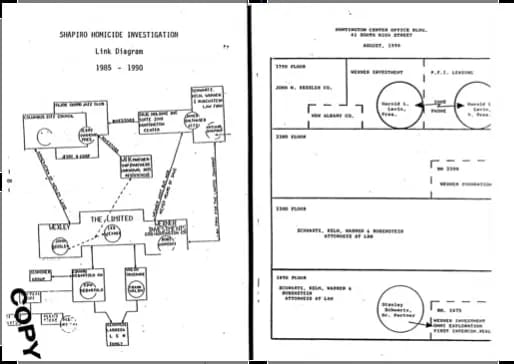
In June 1991, a civilian analyst at the Columbus Police Organized Crime Bureau, a man named Leupp, completed an internal memorandum titled "Shapiro Homicide Investigation: Analysis and Hypothesis." The report had originally been commissioned "because of the strong similarities between this homicide and a Mafia (L.C.N.) 'hit,'" where L.C.N. stands for La Cosa Nostra.
The analysis went beyond the dynamics of the execution. Leupp mapped a network of "unusual interactive relations" among several organizations: The Limited, the Walsh Trucking Company, the law firm Schwartz, Kelm, Warren & Rubenstein (successor to Shapiro's firm), the Omni Oil Company, the Edward DeBartolo Company of Youngstown, and local developer John W. Kessler. At the center of this web was Leslie Wexner.
The two most significant names in the report were Francis J. "Frank" Walsh and Edward DeBartolo Sr., two figures whose ties to organized crime were documented by state anti-Mafia commissions and the federal task force.
Walsh was the owner of the Walsh Trucking Company of New Jersey, the transport company that handled the main logistics for The Limited in Columbus. In 1984, Walsh was under investigation by the New York Organized Crime Task Force for his ties to the Genovese family, at the time the second most powerful Mafia family in America after the Gambino. The links between Walsh and the Mob would surface again later. In 2003, the Teamsters union filed formal internal charges against a member of its executive board, Donato DeSanti, for helping Walsh, already convicted of labor racketeering and with established ties to organized crime, manipulate officials of a local union chapter. In short, the man who transported Victoria's Secret merchandise was connected to Cosa Nostra and continued to work for The Limited even in 1990, five years after Shapiro's murder.
DeBartolo Sr., the real estate tycoon from Youngstown, was Wexner's partner in two hostile takeover attempts in 1984 and 1986 for the Carter-Hawley-Hale chain (owner of Neiman Marcus and Bergdorf Goodman). DeBartolo had been repeatedly investigated by federal authorities for his ties to organized crime, specifically the Pittsburgh-based Genovese-LaRocca family, a branch of the Genovese family whose territory extended from West Virginia to eastern Ohio. The LaRocca family, according to the Pennsylvania Crime Commission, was entrenched in construction, trucking, food service, and vending businesses — exactly the sectors where Wexner's and his associates' dealings intersected.
The analyst Leupp's conclusion was: "From the predicate facts presented, it appears that Les Wexner had established contact with associates reputed to be organized crime figures, one of whom was a major investment partner and another was using The Limited headquarters as a mailing address." Leupp added that "it can be hypothesized that the Genovese/LaRocca crime families might consider Wexner a friend."
The report stated that "Arthur Shapiro, had he been alive, could have answered many such questions." And it added a detail about the position of the surviving partner, Stanley Schwartz. The latter "may now answer some of the same questions for the same reason, but he is not before a grand jury, he is immersed in the pattern itself, and now has a powerful incentive to maintain discretion" — suggesting that the partner was too frightened to talk.
What happened next is perhaps the most incredible part of this story. The Columbus police chief, James G. Jackson, ordered the destruction of the Leupp report. A subsequent municipal investigation formally accused him of attempting to make the document disappear, and Jackson was suspended from duty. The police chief admitted to destroying it, but justified himself by claiming that the theories about Mafia ties involving "prominent citizens of Columbus" were purely speculative.
The report could have died there. But it didn't. A local investigative journalist, Bob Fitrakis, managed to obtain a copy when the document was accidentally released in response to a public records request, and he published its contents in the weekly Columbus Alive. Without that bureaucratic error, one of the most revealing documents in Ohio's criminal history would have vanished forever.
From Shapiro to Epstein: the replacement
In the Epstein case timeline, there is a detail that is rarely emphasized but which, in light of the Shapiro murder, takes on a different significance. Jeffrey Epstein entered Leslie Wexner's orbit about a year after that assassination. By the mid-1980s, the former math teacher without a college degree had transformed himself into the trusted financial manager of Ohio's billionaire. It was Epstein, in short, who inherited the role that had, in some way, been Shapiro's, that of the man who managed the money, who knew the numbers, and who therefore had access to Wexner's financial secrets.
Shapiro's name has now resurfaced, decades later, in an FBI file related to Jeffrey Epstein himself. According to a journalistic account citing David Sturtz, the State Inspector General of Ohio, the latter had been gathering evidence against Wexner and Epstein regarding allegations of corruption and other information connected to the Shapiro murder.
Sturtz perceived Epstein as Shapiro's "replacement" in the role of Wexner's trusted man, and referred to him as Wexner's "boyfriend," but the role was broader. Epstein had relationships with highly influential figures, including Bill Clinton and Prince Andrew, as well as ties to intelligence circles.
According to Bob Fitrakis's reporting and the local investigative sources he cited, Epstein allegedly played an important role in bringing the Southern Air Transport company to operate out of Rickenbacker International Airport, in the Columbus, Ohio area. The airline, formerly owned by the CIA and connected to the Air America/Air Asia complex, was known for its involvement in the Iran-Contra scandal, its connections to the supply operations for the Contras in Nicaragua, and for drug trafficking.
Edmund James, of the development firm James and Donohew Development Services, stated that "much of the Hong Kong-to-Rickenbacker cargo was for The Limited." In other words, Epstein was behind the air traffic of a CIA-linked airline that transported goods for Wexner in the same city where his lawyer had been killed in an unsolved murder described as "mob-style" and deemed by several investigators to be consistent with an organized crime execution.
Both Epstein and Shapiro were, in short, connected by the same thread — Leslie Wexner's money and the secrets that money carried with it.
On February 10, 2026, Congressman Ro Khanna publicly revealed that the FBI had classified Wexner as a potential unindicted co-conspirator in the Epstein case. The following day, a federal court in Ohio rejected Wexner's request to block a subpoena to testify in a case involving him. For the first time in forty years, the net appears to be closing around the billionaire from Columbus.
Until the next Debrief,
Sacha and Luigi
More things you weren't supposed to know about Jeffrey Epstein
Was Jeffrey Epstein a Mossad Agent Working for Israel? What secret emails reveal New revelations show Epstein acting as a go-between for Israeli intelligence operations.
Epstein increasingly appears to have operated for multiple intelligence services The newly released Epstein Files cast a harsher light on an international espionage dimension.
The Butler Who Knew Too Much: The Story of Alfredo Rodriguez and Epstein's Black Book Epstein's butler tried to sell the "Holy Grail" to an undercover FBI agent — then died before he could say more.
The survivors who fought Epstein (and whom nobody wanted to listen to for decades) For almost thirty years police, the FBI, and courts knew — and did nothing.
All of Jeffrey Epstein's Hidden Cameras Every residence wired with hidden cameras — and a foreign government ran surveillance where his victims lived.
The Hotel of Secrets and the Soulmate of Ghislaine Maxwell A former Russian senator, who described himself as the soulmate of Ghislaine Maxwell and claimed to have been in contact with Jeffrey Epstein in Moscow, was found dead
The decision is yours

Confusing, jargon-packed, and time-consuming. Or quick, direct, and actually enjoyable.
Easy choice.
There’s a reason over 4 million professionals read Morning Brew instead of traditional business media. The facts hit harder, it’s built to be skimmed, and for once, business news is something you actually look forward to reading.
Try Morning Brew’s newsletter for free and realize just how good business news can be.
If you've come across an undercover investigation you think we should feature, share it with us here:
👉 https://forms.gle/1JbqMBJUfoRU9MBp7
If you have suggestions, questions, tips (or insults), drop us a line at:
👉 [email protected]
If you enjoyed this newsletter, pass it along to your friends using this link:
👉 https://debrief-newsletter.beehiiv.com/
Follow us on Instagram, occasionally we'll upload content different from the newsletter:
👉 https://www.instagram.com/debrief_undercover/
We've also launched a podcast featuring interviews with the authors of memorable undercover investigations:
👉 https://open.spotify.com/show
And if that's still not enough, join our Telegram channel, where we can keep the conversation going:
👉 https://t.me/debrief_undercover
Reply